
Introduction
What if your organic traffic is growing, but your ad revenue remains flat? This is the exact plateau a leading personal finance site faced before they partnered with us. They were creating excellent, in-depth content and attracting a sizeable audience, but their monetization engine was sputtering, leaving significant money on the table every month.
In just 90 days, we implemented a targeted strategy that not only grew their traffic but increased their total ad revenue by 120%—without sacrificing user experience. The client, a personal finance blog focused on investing for millennials, had solid content but untapped revenue potential locked behind technical debt and a passive monetization strategy.
This case study pulls back the curtain on our process. We'll walk you through the initial diagnosis, our three-pillar strategic framework for growth, the month-by-month execution, and the final, game-changing results that transformed their website into a high-performance revenue asset.
Section 1: The Challenge: A Revenue Ceiling at Scale
Before our engagement, the client's site was successful by many measures but had hit a frustrating ceiling. They had a loyal audience but couldn't seem to translate their traffic growth into proportional revenue growth. Our initial deep-dive audit revealed a clear "before" snapshot.
Baseline Metrics (Pre-Engagement):
- Monthly Organic Traffic: ~150,000 sessions
- Monthly Ad Revenue: ~$12,000
- Average Session RPM (Revenue Per Mille): ~$80
- Key Pain Points: Stagnant traffic on high-value commercial pages, poor Core Web Vitals scores causing a sluggish user experience, and an unoptimized ad layout that was hurting ad viewability.
Our audit pinpointed three core problems that were acting as a drag on their revenue potential:
- Content Cannibalization: The site had multiple articles competing for the same high-value keywords. For instance, separate posts on "best robo-advisors," "robo-advisor reviews," and "top robo-advisor platforms" were all fighting each other in the SERPs, diluting their authority and preventing any single page from achieving its maximum rank.
- Technical Debt: Poor site speed, with a Largest Contentful Paint (LCP) of over 4 seconds, was a major issue. This, combined with a low mobile usability score, directly impacted user engagement. Slow-loading pages mean users bounce, and ads that don't load quickly are never seen, crushing ad viewability and CPMs.
- Passive Monetization: The site was running a standard, out-of-the-box ad setup from their ad network. There was no strategy for optimizing ad placements, no consideration for high-RPM geographic locations, and no A/B testing to find the highest-performing ad units. It was a classic "set it and forget it" approach that was costing them thousands.
Section 2: The Strategic Blueprint: Our 3-Pillar Growth Framework
Our approach isn't about chasing fleeting algorithm updates. It's a holistic framework built on three synergistic pillars designed to create sustainable, long-term growth: SEO Foundation, High-Value Content, and Strategic Monetization.
Pillar 1: Revitalizing the SEO Foundation (Technical & On-Page)
Before we could effectively scale content or revenue, we had to fix the leaking bucket. That meant shoring up the site's technical health.
- The Audit: We began with a comprehensive technical SEO audit to identify every issue holding the site back, from broken links to indexation bloat.
- Core Web Vitals Optimization: This was our top priority. Our development team got to work immediately. We deferred non-critical JavaScript, implemented lazy loading for images and ads, and optimized the server response time. These actions dramatically improved the user experience, improving LCP from a sluggish 4.2s to a crisp 2.1s.
- Internal Linking & Topical Authority: We dismantled the competing content silos. By merging and redirecting cannibalized articles and restructuring the site's internal links, we created powerful content hubs. This signaled clear topical authority to Google on lucrative topics like "Investing" and "Retirement Planning," helping the primary "money pages" rank higher.
- Schema Markup: To maximize SERP real estate and click-through rates, we implemented
FAQPageandArticleschema on all relevant posts. This helped the site win valuable rich snippets, making their listings more prominent and appealing to searchers.
Pillar 2: The High-Value Content Overhaul (The E-E-A-T Engine)
In the competitive finance niche, YMYL (Your Money or Your Life) content must scream E-E-A-T (Experience, Expertise, Authoritativeness, Trustworthiness). Our content strategy was designed to do just that.
- From Keywords to Topics: We shifted the client's focus from targeting single, disconnected keywords to building comprehensive topic clusters. This approach demonstrates deep expertise and satisfies Google's desire to rank pages that cover a subject in its entirety.
- The Content Refresh Initiative: We applied the 80/20 rule. Instead of starting from scratch, we identified the top 20% of pages that had the potential to drive 80% of the traffic and revenue. These became our primary targets for a strategic content refresh.
Our Refresh Process in Action (Example):
- Original Post: "Best Robo-Advisors 2022"
- Analysis: The post was ranking on page two. It had outdated information, lacked unique insights, and failed to demonstrate first-hand experience.
- The Refresh: We transformed the article. We added new sections comparing complex fee structures in simple terms, included unique screenshots of the user interface to prove we'd actually used the platforms (demonstrating Experience), updated all performance data for the current year, and embedded a quote from a certified financial planner (Expertise).
- Targeting High-RPM Keywords: Our
finance site SEO strategywas directly tied to monetization. Using tools like Ahrefs and Semrush, we cross-referenced keyword data with the client's ad network reports. This allowed us to find and prioritize keywords that attract high-value advertisers. We focused on commercial-intent terms like "best high-yield savings accounts" over informational terms like "what is a savings account," ensuring that new traffic was more valuable.
Pillar 3: Strategic Ad Monetization
Traffic is only half the equation. A successful ad revenue optimization strategy focuses on maximizing the value of every single visitor.
- Beyond Default Settings: We moved the client from a passive to an active monetization model.
- Ad Layout Optimization: We analyzed user behavior data to redesign the ad layout. We removed the low-performing 728x90 leaderboard ad in the header, added a high-viewability sticky sidebar ad for desktop users, and implemented an in-content ad after the third paragraph, where engagement is highest.
- Improving Ad Viewability: Our work on Core Web Vitals in Pillar 1 had a direct and powerful impact here. A faster site means ads load and become viewable more quickly, which drastically increases the CPMs advertisers are willing to pay.
- Working with Ad Partners: We established a direct line of communication with their premium ad management partner, IMC. This allowed us to collaborate on A/B testing ad placements, density, and formats to dial in the perfect balance between revenue and user experience.
Section 3: The 90-Day Execution Plan
Our strategy was broken down into a clear, actionable timeline. This phased approach allowed us to secure quick wins while building momentum for compounding long-term growth.
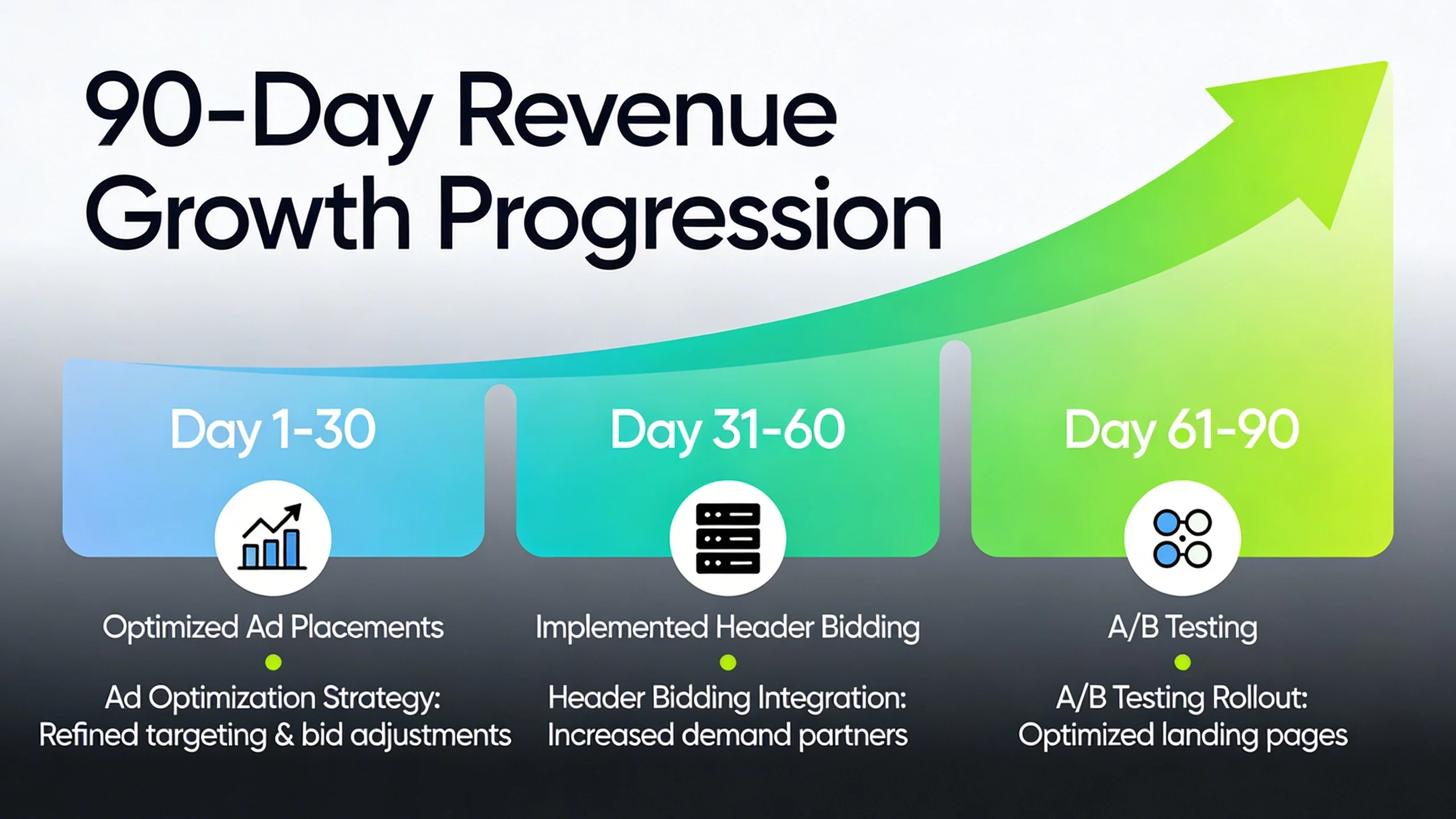
- Month 1 (Days 1-30): Foundation & Low-Hanging Fruit
* Completed the full technical, content, and monetization audits.
* Resolved all critical Core Web Vitals and site speed issues.
* Executed our content refresh strategy for SEO on the top 5 highest-potential articles.
* Implemented the initial, data-backed ad layout changes.
- Month 2 (Days 31-60): Scaling Content & Optimization
* Refreshed an additional 15 key articles, expanding our reach on high-value topics.
* Began creating new "spoke" content to support the main topic "hubs."
* A/B tested ad placements in collaboration with the ad network and identified winning combinations.
* Began seeing significant initial lifts in organic traffic and session RPMs.
- Month 3 (Days 61-90): Compounding Growth & Analysis
* Continued the content refresh and creation cycle, building on our momentum.
* Analyzed early results from Google Search Console and Google Analytics to double down on what was working.
* Worked with the ad network to enable higher-paying ad formats, like video units, on qualified pages.
* The "hockey stick" growth curve began to appear as all three pillars worked in synergy.
Section 4: The Results: A 120% Revenue Transformation
The results of our integrated 90-day strategy were dramatic. By focusing on the entire monetization ecosystem—from technical health to content quality to ad layout—we achieved transformative growth.
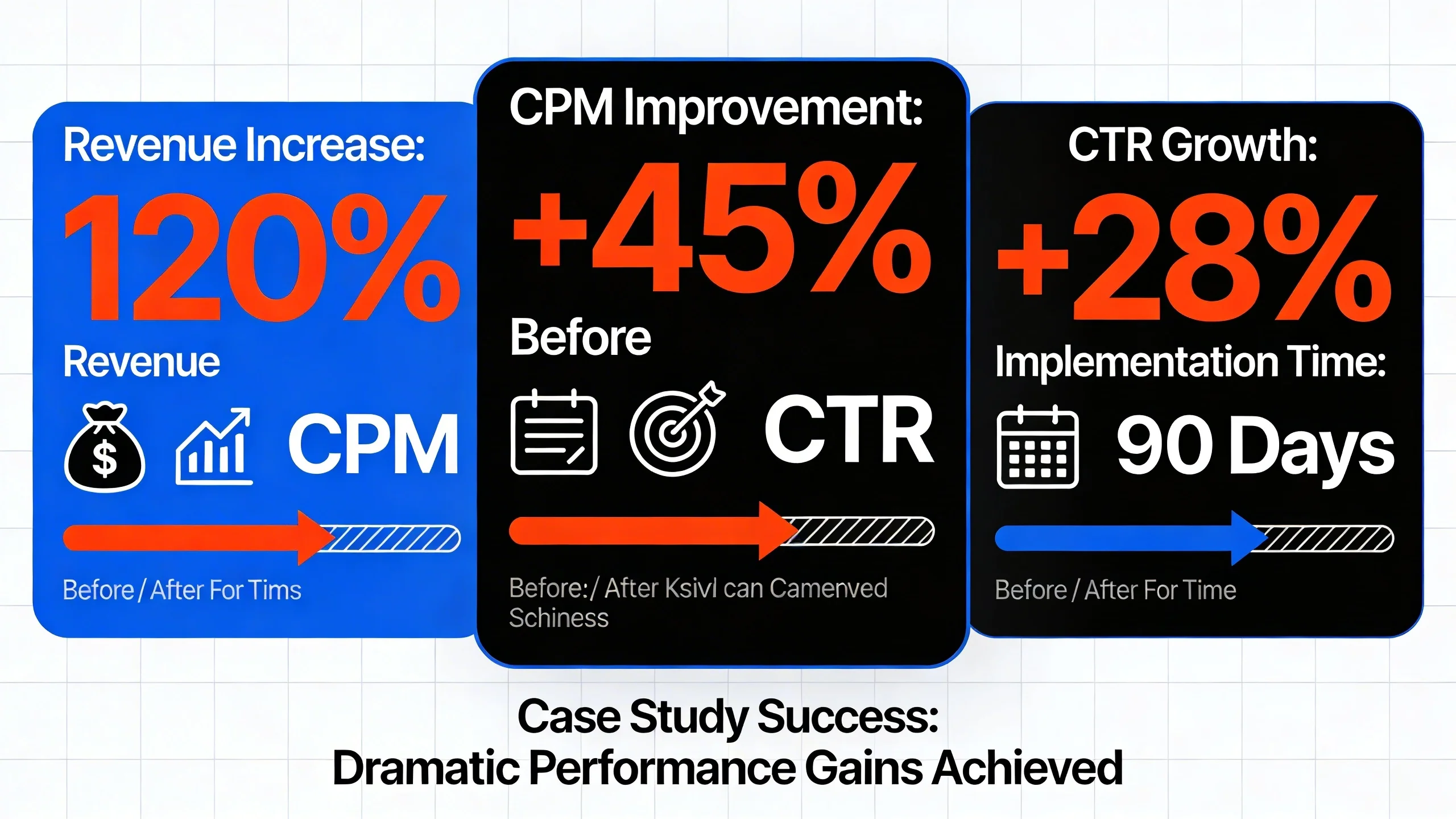
The Headline Numbers: In just 90 days, we increased the site's monthly ad revenue from $12,000 to $26,400—a 120% increase.
[Visual 1: A bar chart would be placed here showing monthly ad revenue: Month 0 ($12,000), Month 1 ($15,500), Month 2 ($21,000), Month 3 ($26,400)]
The revenue growth was driven by substantial improvements across all key performance indicators.
The "How We Got There" Metrics (Before & After):
| Metric | Before (Day 0) | After (Day 90) | % Change |
|---|---|---|---|
| Monthly Ad Revenue | $12,000 | $26,400 | +120% |
| Average Session RPM | $80 | $115 | +43% |
| Organic Sessions | 150,000 | 230,000 | +53% |
| Clicks (GSC) | 120,000 | 195,000 | +62.5% |
| LCP (Largest Contentful Paint) | 4.2s | 2.1s | -50% |
This wasn't just about one metric; it was about the powerful compounding effect of our 3-pillar strategy. The 43% increase in session RPM was a direct result of improved site speed, better ad viewability, and a smarter ad layout. The 53% increase in organic traffic was driven by the E-E-A-T-focused content refreshes and superior technical SEO. The 120% revenue lift is the powerful combination of both—more traffic, with every visitor being more valuable.
Section 5: 3 Replicable Lessons for Your Finance Site
This increase ad revenue case study highlights several universal truths for publishers. Here are three actionable lessons you can apply to your own site.
- Treat Content as an Asset, Not a Commodity: Your existing content is a goldmine. Before pouring your budget into creating dozens of new articles, audit what you already have. Prioritizing the strategic refresh of your highest-potential articles often yields a much higher and faster ROI.
- Revenue is a Function of UX, Not Just Traffic: Never forget that site speed and a clean user experience directly translate to higher ad viewability and better RPMs. Don't sacrifice a good user experience for a few extra ad slots; it's a trade-off that will cost you more in the long run.
- Integrate Your SEO and Monetization Strategies: These two functions should not operate in separate silos. Your keyword strategy should inform your ad strategy, and vice-versa. Actively pursue a
high RPM keyword strategyby targeting topics that high-paying advertisers in your niche are desperate to reach.
Conclusion & Call to Action
In 90 days, we took a successful finance blog from a state of stagnant revenue to a high-growth, highly-optimized digital asset. The journey from $12,000 to over $26,000 in monthly ad revenue wasn't an accident; it was the result of a deliberate, data-driven strategy that aligns high-quality content with smart monetization.
This process proves that significant growth is possible when you treat your website as an integrated system where technical performance, content quality, and revenue strategy all work together.
If your site is facing a similar revenue plateau, it might be time for a strategic overhaul. It's time to stop leaving money on the table.
Schedule a free, no-obligation discovery call with our team to uncover your site's hidden revenue potential.
Want more strategies like this? Subscribe to our newsletter for exclusive case studies and insights.