
Phase 1: Diagnose Before You Act (Don't Panic, Analyze)
Jumping into random changes without understanding the problem is like trying to fix an engine by kicking the tires. Before you change a single word on your site, you must become a detective. Your first job is to gather clues and confirm your suspicions.
First, Confirm It Was an Algorithm Update
Was your traffic drop a coincidence, a technical glitch, or the result of a confirmed Google update? Here’s how to find out.
Check Official Channels
Your primary sources of truth are Google themselves. Monitor the Google Search Central Blog and their official X account, @googlesearchc. They typically announce the start and completion of major core updates and provide information on significant new systems like the Helpful Content update.
Monitor Reputable SEO News Sites
Industry publications like Search Engine Land and Search Engine Journal have their ears to the ground. They often report on unconfirmed "tremors" in the search results and provide community analysis once an update is officially announced. They are invaluable for context and timing.
Correlate the Dates
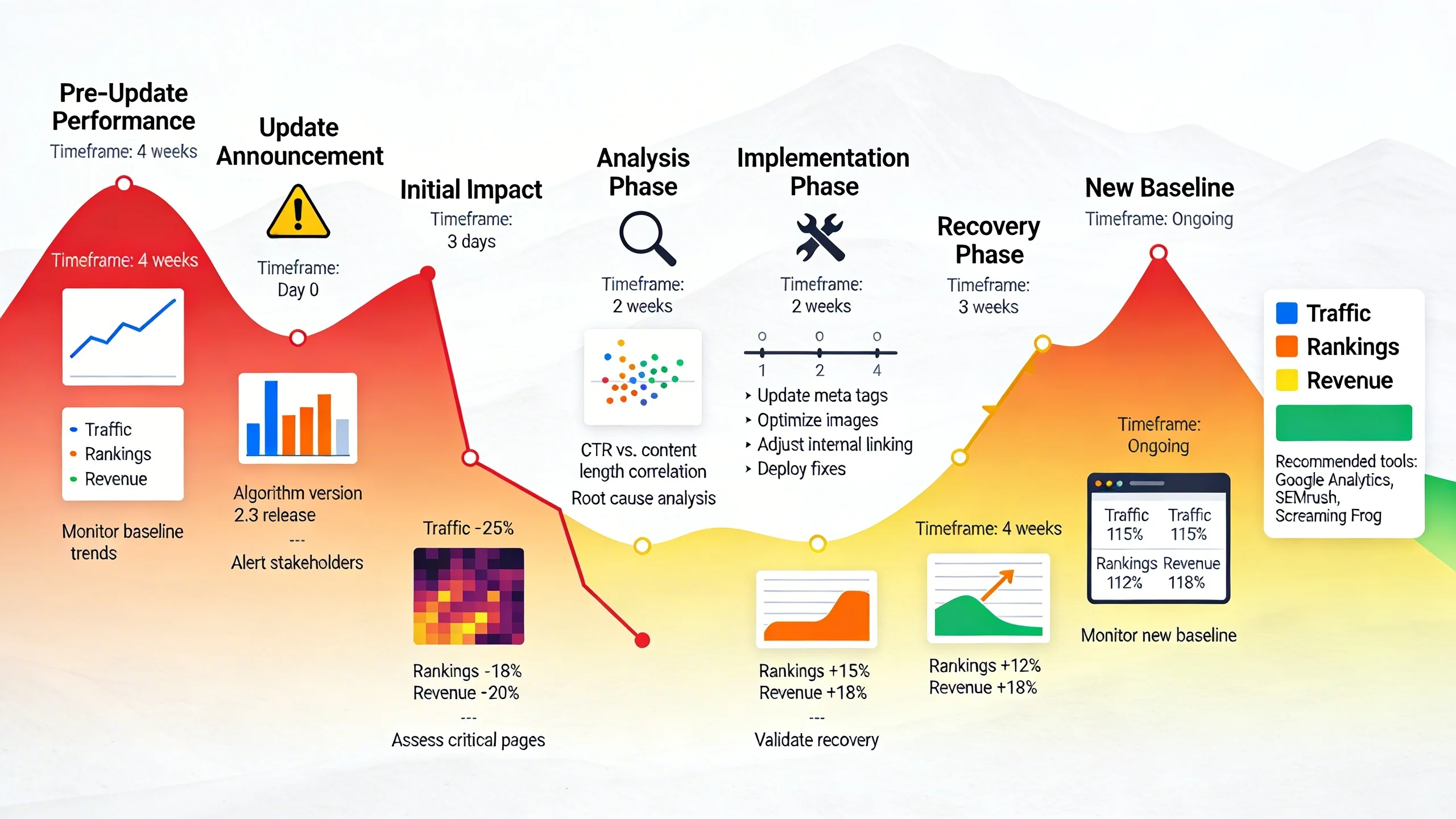
This is the most critical step. Open your analytics platform. Pinpoint the exact day your traffic began to decline sharply. Now, compare that date with the dates of the confirmed (or widely reported) algorithm update. If they align perfectly, you have your culprit.
Pinpoint the Damage: A Deep Dive into Your Data
Now that you know an update was the cause, you need to understand the effect. What specific parts of your site were hit? This is where Google Search Console and Google Analytics 4 become your most important tools.
Google Search Console (GSC) Analysis:
GSC tells you how Google sees your site. It’s non-negotiable for this analysis.
- Performance Report: Go to the Performance report and set the date range to compare the period before the update with the period after.
- Which queries were hit hardest? Click on the "Queries" tab. Sort by "Clicks Difference" to see which keywords lost the most visibility. Are they primarily informational ("how to...") or commercial ("best...")? This is a huge clue about what Google devalued.
- Which pages lost the most traffic? Switch to the "Pages" tab. Again, sort by difference. Are your most important "money pages" affected? Is it a specific category of articles? This helps you narrow your focus.
- Check for patterns: Did a specific subdirectory get hit? For example, if you notice that pages within your
/reviews/folder were disproportionately affected, it strongly suggests the update targeted the quality signals related to your review content.
Google Analytics 4 (GA4) Insights:
GA4 tells you how users behave once they arrive.
- Analyze Organic Search Traffic: In your GA4 reports, isolate the "Organic Search" channel. Confirm the drop you saw in GSC is reflected here.
- Look at Engagement Metrics: Did user engagement metrics like Engaged sessions or Engagement rate also drop for the pages that lost traffic? A decline here can signal that even when users did arrive, they weren't finding the content helpful or relevant, which is a major red flag for systems like the Helpful Content Update.
---
Phase 2: The Publisher's Recovery Audit (Aligning with Google's Core Principles)
With your diagnosis complete, it's time to move to the audit. This is the heart of your google update recovery plan. For modern publishers, recovery almost always comes down to ruthlessly evaluating your content and user experience against Google's quality standards, encapsulated by E-E-A-T.
The Heart of the Matter: A Ruthless E-E-A-T and Content Quality Audit
Most modern updates, especially Core and Helpful Content updates, are designed to better reward content that demonstrates strong Experience, Expertise, Authoritativeness, and Trustworthiness (E-E-A-T). Your job is to look at your site through this lens.
Ask Google's Questions (The Helpful Content Framework):
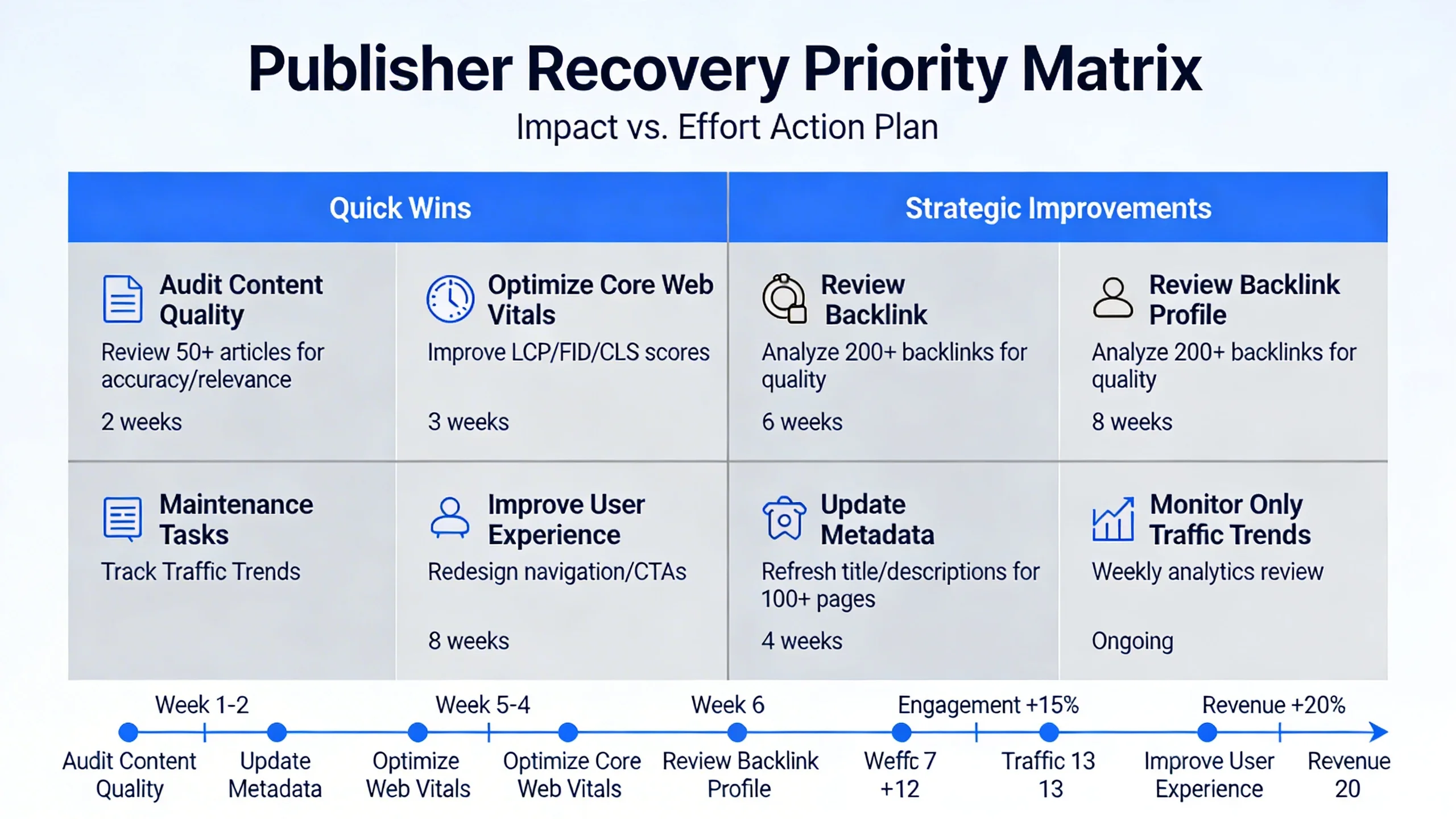
Google has given us the questions they ask themselves when evaluating content. Turn these into an actionable content quality checklist google for your most-affected pages.
- Does your content clearly demonstrate first-hand experience? For a product review, does the content show you've actually used the product with original photos or unique insights? For a travel guide, does it feel like it was written by someone who has been there? The era of summarizing other websites is over.
- Is this content written for humans first, search engines second? Read your articles aloud. Do they sound natural, or are they awkwardly stuffed with keywords? Does the content directly and satisfyingly answer the user's question?
- Are you writing to a particular niche, or are you trying to cover everything? Google wants to rank sites with clear topical authority. If your gardening blog suddenly has articles about cryptocurrency, it dilutes your expertise and authority.
- After reading your content, will someone feel they've learned enough to achieve their goal? Does your article on "how to bake sourdough" leave the reader confident, or do they need to click back to Google and find another guide? Aim for completeness and value.
[Secondary CTA]
Want to systematize this process? Download our free 50-point Publisher's Content Quality Checklist. It's the same one our experts use to vet content for helpfulness and E-E-A-T.
[Button: Download the Checklist]
Strengthening Author and Site Trust Signals:
E-E-A-T for publishers isn't just about the words on the page; it's about the trust signals surrounding them.
- Author Bios: Are your author bios detailed? A bio that just says "John is a writer" is useless. It should be "John is a certified financial planner with 15 years of experience..." and link to their professional LinkedIn or a dedicated author page showcasing their credentials and portfolio.
- About Us / Contact Pages: Your "About Us" page is one of the most important on your site. It must be robust and transparent. Explain who is behind the site, what your mission is, and why you are qualified to give advice on your topic. A clear contact page with an address (if applicable), email, and phone number also builds trust.
- Sourcing and Citations: For any claims, especially on YMYL (Your Money, Your Life) topics like health or finance, you must back them up by linking out to credible, primary sources (e.g., scientific studies, government reports, expert interviews).
Re-evaluating User Experience (UX) & On-Page Signals
For publishers monetizing with ads and affiliates, user experience is a delicate balancing act. An algorithm update might be Google's way of telling you that the balance has tipped too far away from the user. This is a critical part of improving user experience for seo.
Core Web Vitals (CWV) & Page Experience:
Don't just look at the pass/fail score in GSC. Experience your site as a user would.
- Layout Shift (CLS): Do ads, images, or cookie banners cause the content to jump around as the page loads? This is intensely frustrating for users and a direct hit to your CLS score.
- Loading Speed (LCP): Are massive, unoptimized images or heavy ad scripts making your most important content slow to appear?
- Mobile-Friendliness and Readability: Open your hardest-hit pages on a real phone. Is the font size legible? Are buttons and links easy to tap? Most importantly, are intrusive pop-ups or sticky ads covering the content and making it impossible to read?
- Ad Experience: Be honest. Is your content overwhelmed by ads? Are there more ads "above the fold" than actual content? This is a primary factor in what Google considers "unhelpful," and a common reason for
google helpful content update recoveryefforts.
The "Prune and Improve" Strategy: A Content-First Approach
You can't fix everything at once. A content-first audit helps you prioritize. This is where you conduct an seo audit after algorithm update focused entirely on your content assets.
Identify Underperforming Content:
Using the GSC and GA4 data you gathered in Phase 1, create a list of pages that have low traffic, poor engagement, and few (or no) backlinks. These pages are likely dragging down the overall quality score of your entire site.
The Decision Framework: Improve, Consolidate, or Delete?
For each underperforming URL, assign it to one of three buckets:
- Improve: The article is on a valuable topic but is thin, outdated, or fails your new E-E-A-T audit. Action: Schedule a complete rewrite. Add first-hand experience, update facts and figures, include original media, and strengthen author expertise signals.
- Consolidate: You have multiple, similar articles competing for the same keywords (keyword cannibalization). For example, "Best Running Shoes for Beginners" and "Top 5 Beginner Running Shoes." Action: Merge the best elements of each into one definitive "mega-guide." Publish it on the strongest URL and 301 redirect the other articles to it.
- Delete: The content is low-quality, completely irrelevant to your site's core topic, and has no traffic or backlinks. It provides zero value. Action: Prune it. Deleting this content tells Google you're serious about quality. Use a 410 "Content Deleted" status code to tell Google to remove it from its index quickly.
---
Phase 3: The Technical SEO Health Check for Publishers
While modern updates are heavily focused on content and E-E-A-T, you can't ignore the technical foundation. A brilliant article is useless if Google can't find, crawl, and understand it properly.
Ensuring a Solid Foundation for Your Content
Think of technical SEO as the plumbing and wiring of your house. If it's broken, it doesn't matter how beautiful the furniture is.
Site Architecture and Internal Linking:
A logical site structure helps both users and search engines.
- Logical Categories: Is your content organized into clear silos or categories? This helps Google understand your site's topical focus.
- Strategic Internal Links: Are you using internal links to pass authority from your highest-performing pages to pages you want to recover? Every new article should link contextually to older, relevant "cornerstone" content, and vice-versa. This creates a strong topical web.
Indexation and Crawl Budget:
For large publishers with thousands of articles, managing what Google crawls is vital.
- Check for Errors: Use GSC's "Pages" (Index Coverage) report to find and fix indexation errors. Are important pages accidentally marked
noindex? - Strategic Noindexing: Use
noindextags purposefully on thin or low-value pages that don't need to rank, such as tag archives, author archives, or old search result pages. This focuses Google's "crawl budget" on your most important content, improving the crawlability of your entire site.
---
Phase 4: Fortify for the Future: Building a Resilient Publishing Business
Recovery is the immediate goal, but resilience is the long-term prize. The final phase is about shifting from a reactive mindset to a proactive one, making your business less fragile to future updates.
Moving from Reactive Recovery to Proactive Prevention
Algorithm updates will never stop. Instead of fearing them, build a site that's aligned with their fundamental goal: rewarding the best content for users.
Make E-E-A-T Part of Your Content Workflow:
Don't wait for an update to audit your content. Turn the "Google's Questions" checklist from Phase 2 into a mandatory pre-publish requirement for every single article. Make E-E-A-T a core part of your content culture.
Focus on Topical Authority, Not Just Keywords:
Stop chasing individual keywords. Instead, plan your content in clusters. If you want to be an authority on "indoor plants," create a comprehensive pillar page and surround it with dozens of specific articles answering every conceivable question on the topic. This demonstrates deep expertise that Google loves.
Diversify Your Traffic Sources:
The ultimate defense against any single algorithm update is to not be 100% reliant on Google. A strong brand is your best moat. Invest in building:
- An engaged email list.
- A loyal social media following.
- A direct, brand-aware readership that types your URL directly into their browser.
---
Conclusion
Recovering from a Google algorithm update is a marathon, not a sprint. It requires patience, data-driven analysis, and an honest recommitment to quality, expertise, and the user experience. There are no quick fixes or silver bullets.
By following this four-phase plan—Diagnose with data, Audit against E-E-A-T, Act on your content and UX, and Fortify for the future—you can move beyond simple recovery. You can begin to build a stronger, more resilient publishing business. Algorithm updates are a constant, but by aligning your site with the goal of providing genuine value, you can build a publishing business that stands the test of time.
[Primary CTA]
Feeling overwhelmed by the audit process? Let our SEO Site Audit tool do the heavy lifting. Get an instant, actionable analysis of your site's E-E-A-T signals, technical health, and content quality.
[Button: Start Your Free Audit]