

The Mindset Shift: Why Keyword Research is Your Most Important Blogging Task
Before we dive into the "how," we need to address the "why." Many passionate bloggers resist keyword research, feeling it's a soulless, technical task that stifles creativity. This couldn't be further from the truth.
Passion is your engine, but keyword research is the steering wheel. It ensures your creative energy is directed toward topics your audience is already desperate to learn about.
Think of it this way: modern keyword research is not about cheating the system or "stuffing" keywords into your articles. It's about market research. It’s about developing deep empathy for your reader, discovering their most pressing questions and pain points, and then creating the best possible content to solve their problems. When you do that, Google rewards you.
To succeed, every topic you choose should satisfy three core pillars.
The Three Pillars of a Perfect Blog Keyword:
- Relevance: The keyword must align perfectly with your niche, your expertise, and the overall theme of your blog. Ranking for "best crypto wallets" is useless if you run a blog about sourdough bread.
- Search Volume: A reasonable number of people need to be searching for the term. We're not chasing millions, but we need to know there's an audience for our work.
- Low Competition: You must have a realistic chance of ranking on the first page of Google. This is where new bloggers win—by avoiding the crowded battlefields and finding the unguarded flanks.
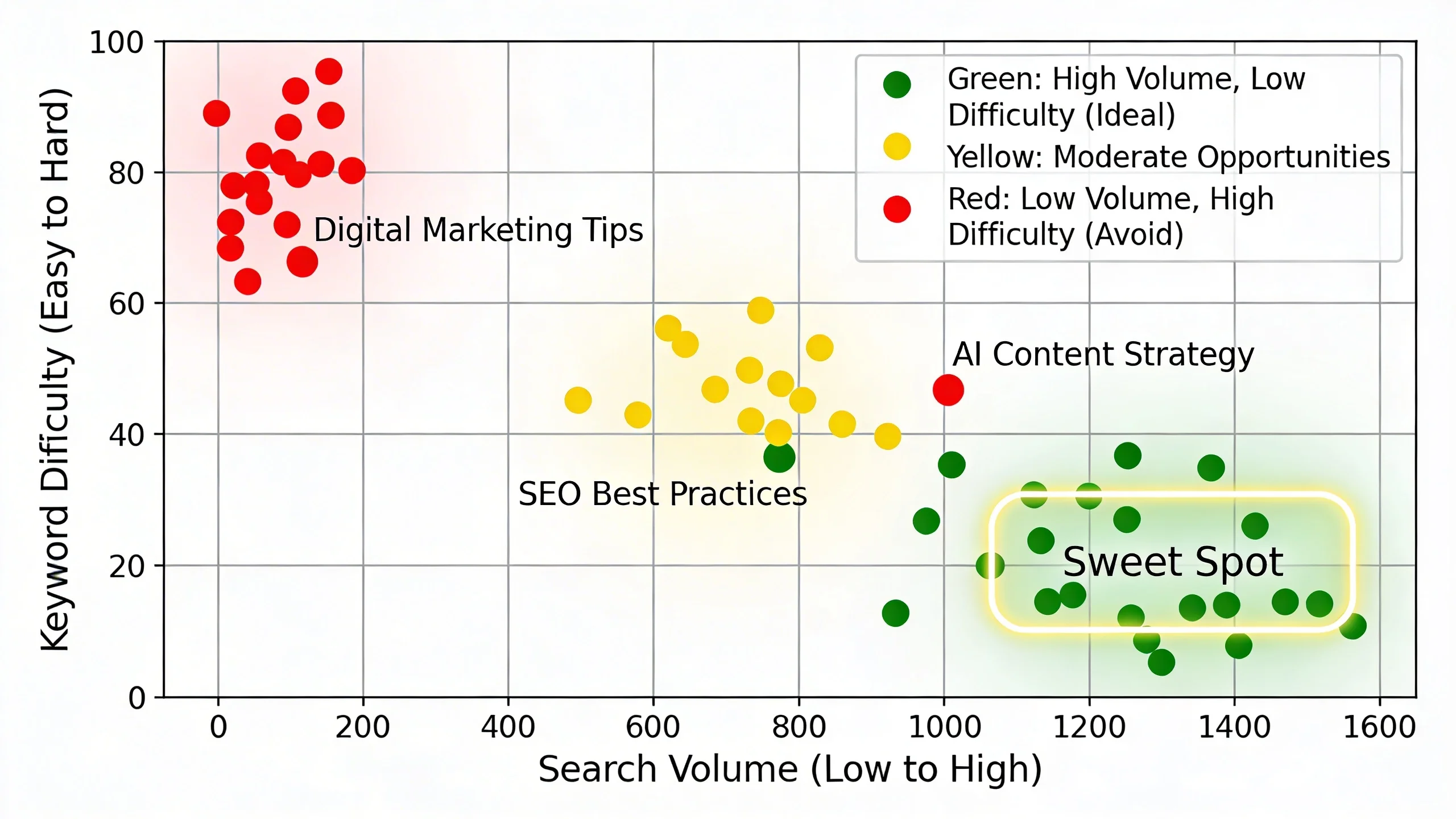
To find keywords that hit this sweet spot, you need to understand two foundational concepts.
What are Long-Tail Keywords (and Why They're a Blogger's Best Friend)?
Imagine you're selling shoes. Trying to rank for the keyword shoes is impossible. You’d be competing with Nike, Adidas, and every retail giant on the planet. This is a "head term"—short, generic, and hyper-competitive.
Now, consider a more specific search: best waterproof hiking shoes for women with wide feet. This is a long-tail keyword.
It has lower search volume, but the user's intent is crystal clear. They know exactly what they want. For bloggers, these long-tail keywords are pure gold. They are far less competitive and attract a highly motivated, targeted audience that is more likely to read, engage, and trust your content.
Understanding Search Intent: The 'Why' Behind the Query
Search intent is the goal a user has when they type a query into Google. Understanding this is non-negotiable. There are four main types:
- Informational: The user wants to learn something. (e.g., "how to make vegan buttercream frosting")
- Navigational: The user wants to go to a specific website. (e.g., "Facebook login")
- Commercial: The user is investigating products before a potential purchase. (e.g., "best stand mixers for baking")
- Transactional: The user wants to buy something now. (e.g., "buy KitchenAid Artisan mixer")
As a blogger, you will live almost exclusively in the Informational intent world. Your job is to answer questions, solve problems, and provide information. Targeting a keyword with the wrong intent is like showing up to a book club with a chemistry set—you're in the wrong place, and your message won't land.
Your Keyword Research Toolkit: The Best Free & Freemium Tools
You don't need a $100/month subscription to Ahrefs or Semrush to get started. While those tools are incredible, you can uncover amazing keywords using powerful resources that are completely free or offer generous free plans.
Google's Own Goldmine (Completely Free)
Google itself is the most powerful keyword research tool on the planet. You just need to know where to look.
- Google Search & Autocomplete: This is the "Alphabet Soup" method. Start typing a seed keyword like "vegan baking" into the search bar, and see what Google suggests. Then, go through the alphabet: "vegan baking a," "vegan baking b," and so on. These are real searches from real people.
- "People Also Ask" (PAA) Boxes: This is a treasure trove. Search for a topic, and you'll see a box of related questions. Clicking on one reveals an answer and expands the list with even more questions. Each one is a potential blog post topic.
- "Related Searches" Section: Scroll to the very bottom of the search results page (SERP). Here, Google gives you a list of 8-10 other queries related to your original search. It's a goldmine for finding related long-tail keywords.
- Google Keyword Planner: While designed for advertisers, it's a powerful free tool for bloggers. You'll need a Google account. It can give you thousands of keyword ideas based on a seed term. (Pro-tip: The search volume data is given in wide ranges, so use it for ideas and relative comparisons, not exact figures).
Freemium Powerhouses
These tools offer free versions that are more than enough to get you started.
- AnswerThePublic / AlsoAsked: These tools take your seed keyword and visualize it as a web of questions (who, what, why, etc.), prepositions, and comparisons. It’s an incredible way to understand the entire universe of questions surrounding your topic.
- Ubersuggest (Neil Patel): This tool provides a limited number of free daily searches. It’s useful for getting a quick look at keyword ideas, search volume estimates, and a basic Keyword Difficulty (KD) score to get a general sense of competition.
- Ahrefs/Semrush Free Versions: Both of these industry-leading tools offer free keyword generator tools. They give you a small sample of the data their paid versions provide, which is often enough to spark some fantastic ideas.
Community-Driven Research
The best keyword ideas often come from the real-world problems people are discussing online.
- Reddit & Quora: These platforms are raw, unfiltered search engines of human problems. Search for your niche (e.g., r/veganbaking on Reddit) and look for terms like "how to," "question," "help," or "problem." The language people use here is exactly what they're typing into Google.
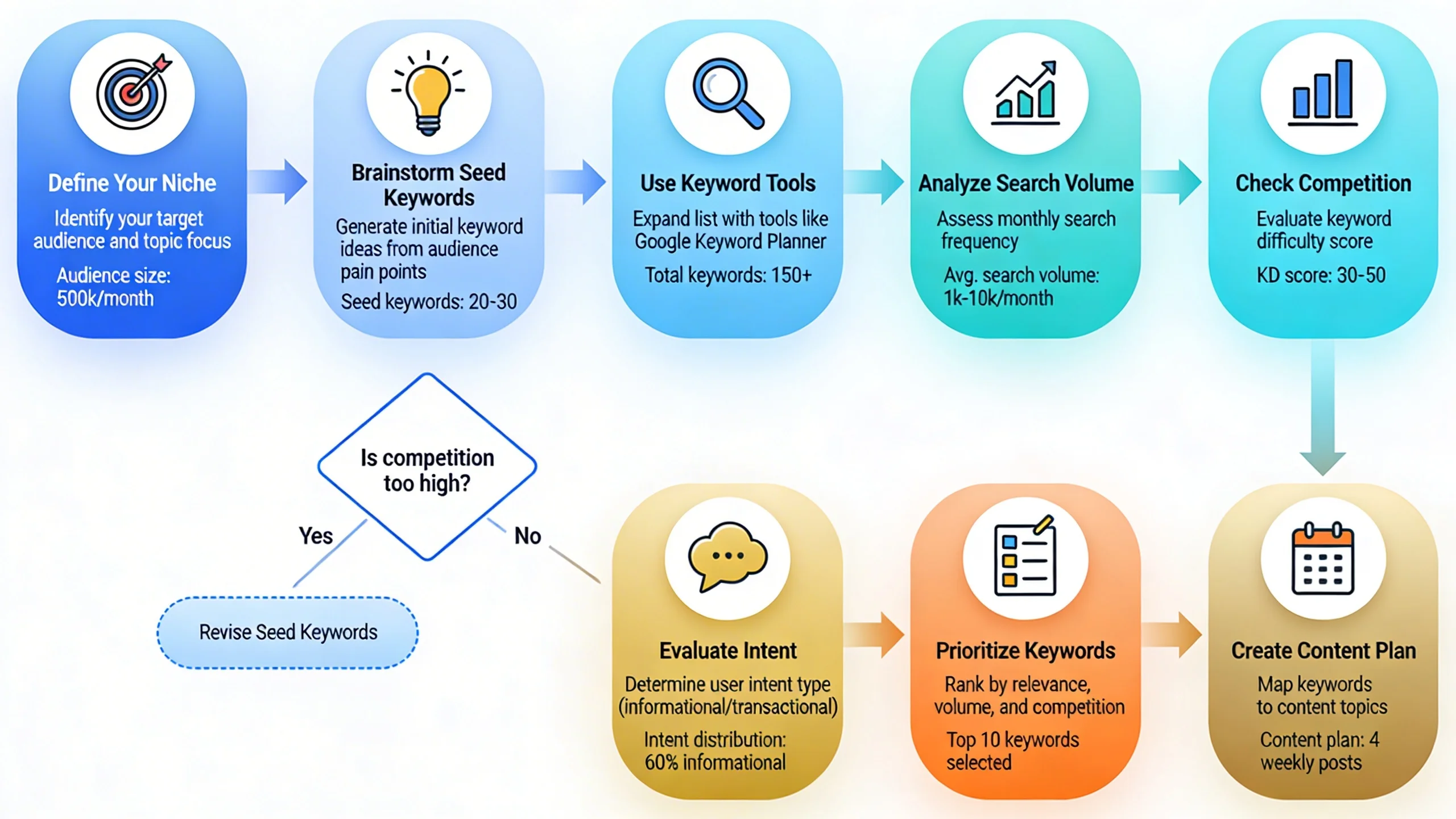
The 5-Step Digital Detective Process for Finding Golden Gap Keywords
Now it's time to put on your detective hat. This is a repeatable, actionable process to find those high-value, low-competition keywords. We'll use a running example of a blog about "vegan baking" to make it concrete.
Step 1: Brainstorm Your "Seed" Keywords (~150 words)
Your investigation starts with clues. Seed keywords are the foundational, 1-2 word topics that define your niche. They are the broad starting points from which our entire investigation will grow. Don't overthink this step. What are the most obvious topics you cover?
- Example: For our vegan baking blog, the seed keywords are obvious:
vegan cake,vegan cookies,egg substitute,dairy-free flour,vegan frosting.
Your Action: Open a notebook or a new spreadsheet and list 5-10 core seed keywords for your blog. These are the pillars of your content.
Step 2: Expand Your List with Your Toolkit (~200 words)
Now, we take our seed keywords and systematically expand them into a long list of potential blog post ideas. This is where you use the tools we just discussed.
- Example: Take the seed keyword
vegan cake.
* Google Autocomplete: Type "how to make vegan cake" and see suggestions like "...rise," "...fluffy," "...without applesauce."
* People Also Ask: Google shows questions like "What can I use instead of eggs in a vegan cake?" and "How do you bind a vegan cake?"
* AnswerThePublic: This might generate ideas like "vegan cake vs regular cake" or "vegan cake for birthday."
* Reddit: A search might reveal a thread titled "Help! My vegan cakes are always so dense. What am I doing wrong?"
Your Action: Create a simple spreadsheet with two columns: "Potential Keyword" and "Source" (e.g., Google PAA, Reddit). Take each of your seed keywords from Step 1 and run them through 2-3 of the free tools. Your goal is to generate a master list of at least 50-100 potential long-tail keywords. Don't judge them yet; just collect the clues.
Step 3: The Competition Filter - How to Actually Spot "Low-Competition" (~300 words)
This is the most important step in the entire process, and it's where most new bloggers go wrong. They rely solely on a "Keyword Difficulty" (KD) score from a tool. These scores are just estimates and can be wildly misleading. The real analysis is manual and takes less than 30 seconds per keyword.
We call this the Manual SERP Analysis.
- Open an Incognito/Private browser window. This ensures the results aren't biased by your personal search history.
- Search for your target long-tail keyword.
- Analyze the Top 10 Results: Who is ranking on page one? Are they massive, high-authority sites like Forbes, The New York Times, Healthline, or Allrecipes? Or are they smaller, niche-specific blogs like yours? If you see other small blogs, that's a good sign.
- Look for "Weak" Content: This is the secret clue. Are there any forum results (Quora, Reddit), user-generated content, or posts with outdated titles (e.g., "Best of 2017") on page one? This is a massive green flag. It means Google is struggling to find high-quality, dedicated content for that query, and your comprehensive blog post could easily take that spot.
- Analyze the Titles: Do the top-ranking titles match your keyword exactly? Or is the keyword just mentioned as an afterthought within a broader article? If it's the latter, you can win by creating a post that is more focused and directly addresses the searcher's query.
- Example: You search for "best dairy-free flour for vegan cakes." On page one, you see two forum threads, a 7-year-old blog post from a small blog, and an article about "10 Vegan Baking Tips" that only briefly mentions flour. This is a golden opportunity.
Step 4: The Value Filter - Is This Topic Worth Your Time? (~200 words)
Low competition is meaningless if the topic provides no value to you or your audience. Now we filter our list of low-competition keywords for "high-value" potential.
- Audience-Building Potential: Does this topic solve a burning, specific problem for your ideal reader? Will a fantastic post on this topic make them trust you and want to subscribe? A post on "how to prevent a vegan cake from being dense" does this perfectly.
- Monetization Potential: Can you naturally incorporate affiliate links in this post? (e.g., linking to specific flour brands on Amazon). Does this topic relate to a digital product you have or could create in the future? (e.g., a "Vegan Baking Essentials" ebook).
- Topical Authority Potential: Does this keyword fit into a larger group of topics you want to be known for? Writing about
dairy-free flourhelps establish your authority on the broader topic of "Vegan Baking Ingredients." This signals to Google that you're an expert in your niche.
Step 5: Prioritize and Plan Your Content Cluster (~150 words)
The final step is to move from a random list of keywords to a strategic content plan. Don't just write one-off posts. Group your related, low-competition, high-value keywords into logical clusters.
This is often called the "Pillar and Cluster" model.
- A Pillar Post is a long, comprehensive guide on a broad topic.
- Cluster Posts are shorter, more specific articles that answer a single question related to that pillar, and they all link back to the pillar.
- Example:
* Pillar Post: "The Ultimate Guide to Vegan Baking"
* Cluster Posts (Your low-competition keywords):
* best egg substitute for vegan brownies
* best dairy-free flour for vegan cakes
* how to make vegan buttercream frosting
* why is my vegan cake so dense
Your Action: Look at your filtered keyword list. Group them into logical themes or "clusters." Plan to write the cluster posts first to build your authority, then link them all together with a comprehensive pillar post.
Beyond the Basics: Common Mistakes & Advanced Tactics
Once you've mastered the 5-step process, you can refine your strategy and avoid common pitfalls.
Mistake #1: Keyword Cannibalization
This happens when you have multiple blog posts that target the same keyword and search intent. Google gets confused about which one to rank, and often, neither of them ranks well. The pillar and cluster model you just learned is the perfect antidote, as it forces you to assign one primary keyword to each page.
Mistake #2: Ignoring SERP Features
Before you write a single word, look at the search results page for your target keyword. What do you see?
- Is there a video carousel? You might need to create a YouTube video to compete.
- Is there a featured snippet at the top? Structure your content with a clear, concise answer right at the beginning.
- Is it full of image packs? You'll need high-quality, original photography.
The SERP tells you exactly what kind of content Google wants to show its users. Don't ignore these clues.
Mistake #3: Chasing Volume Over Intent
It's tempting to go after a keyword with 10,000 monthly searches. But a highly specific, long-tail keyword with only 100 monthly searches that perfectly solves a reader's problem is infinitely more valuable. That reader is more likely to convert, subscribe, and become a loyal fan. Value is not just about volume; it's about relevance.
Pro-Tip: The "Keyword Refresh"
Keyword research isn't a one-time task. Once your blog is established, install Google Search Console (it's free). In the "Performance" report, you can find keywords that you are almost ranking for—queries where you're showing up on page two (positions 11-20). These are your lowest-hanging fruit. Go back to those posts, update and improve the content, and re-optimize them for that specific keyword. You can often jump to page one with minimal effort.
Conclusion
Keyword research is the skill that transforms you from a hopeful writer into a strategic publisher. It's the difference between shouting into the void and having a direct conversation with the exact audience you want to reach.
By following this five-step detective process—Brainstorm -> Expand -> Filter for Competition -> Filter for Value -> Cluster—you can systematically uncover opportunities that your competitors have completely overlooked. You can build a content strategy that consistently attracts the right people to your blog.
The silence is about to end. The perfect keyword is out there, waiting in a golden gap. You just need to be the detective who finds it.
What's the most surprising low-competition keyword you've found for your blog? Share it in the comments below!