
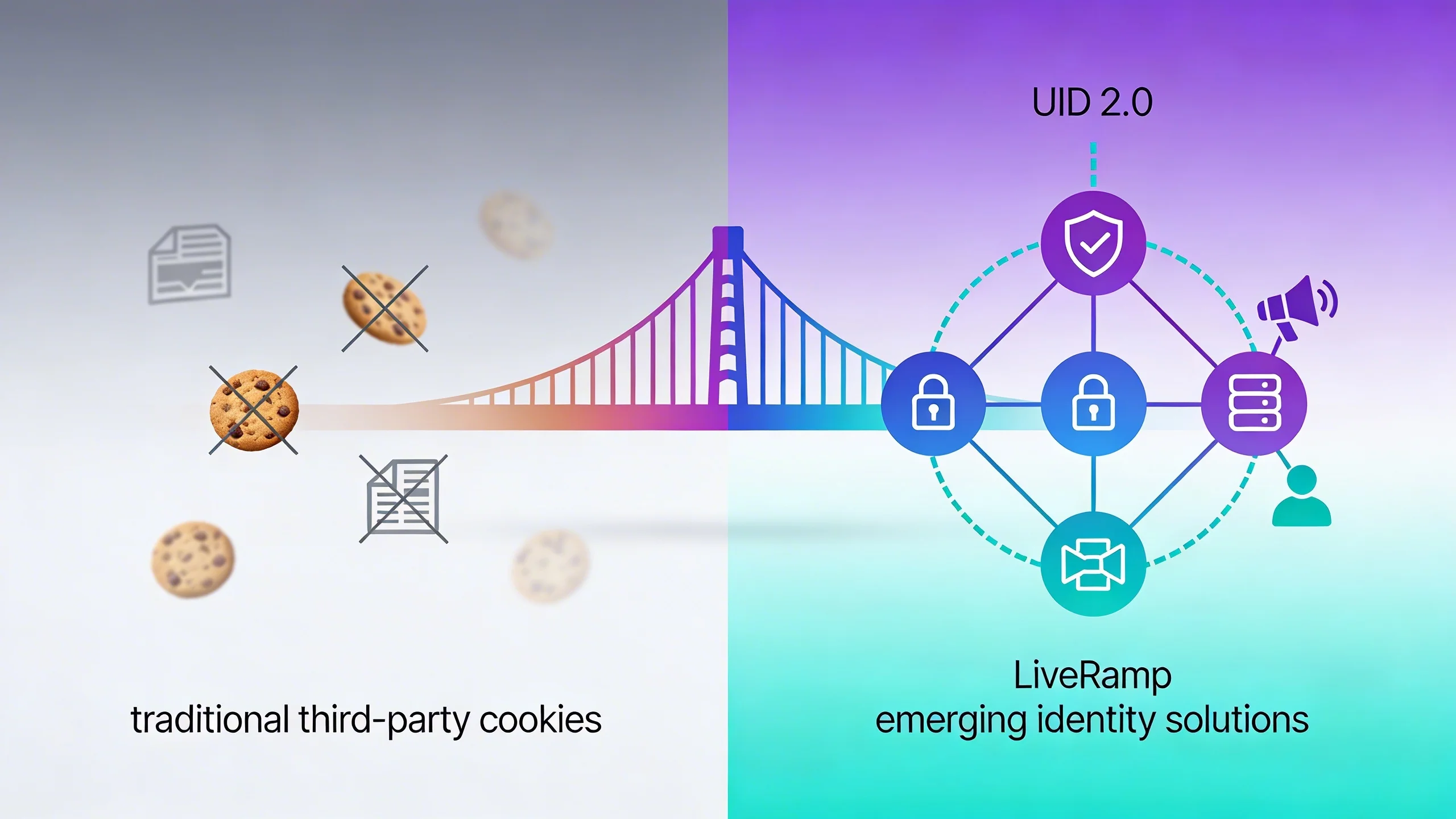
Part 1: Introduction - The Inevitable Shift
The "cookiepocalypse" is no longer a distant threat on the horizon; it's a present reality actively reshaping the digital advertising landscape. For years, the third-party cookie has been the connective tissue of programmatic advertising, but its time is up. As browser restrictions tighten and privacy regulations take center stage, publishers are left facing a wave of confusion, anxiety, and a very real threat to their revenue streams.
The good news? This disruption is also a massive opportunity. The end of the third-party cookie doesn't mean the end of addressable advertising. It signals a necessary evolution towards a more transparent, sustainable, and publisher-centric ecosystem. This article will serve as your definitive guide. We will demystify the complex world of post-cookie identity, compare the leading third-party cookie alternatives, and provide a clear, actionable framework for publishers to not just survive, but thrive by taking control of their audience data.
Part 2: Why We're Here: The Crumbling of the Third-Party Cookie
To navigate the future, we must first understand the forces that dismantled the past. The cookie deprecation wasn't a single event but a culmination of two powerful, intertwined trends: technological restrictions and regulatory pressures.
First, the browsers themselves began to act. Apple’s Safari led the charge with Intelligent Tracking Prevention (ITP), followed by Mozilla’s Firefox with Enhanced Tracking Protection (ETP). These updates effectively blocked third-party cookies by default, creating a significant blind spot for advertisers and a revenue headache for publishers. The final domino is Google Chrome, which has committed to phasing out third-party cookies, impacting the largest share of the web.
Second, a global movement towards consumer data privacy has taken hold. Landmark regulations like the EU's General Data Protection Regulation (GDPR) and the California Consumer Privacy Act (CCPA), along with its successor the CPRA, have fundamentally changed the rules of data collection and usage. These laws mandate user consent and transparency, making the opaque tracking enabled by third-party cookies legally untenable.
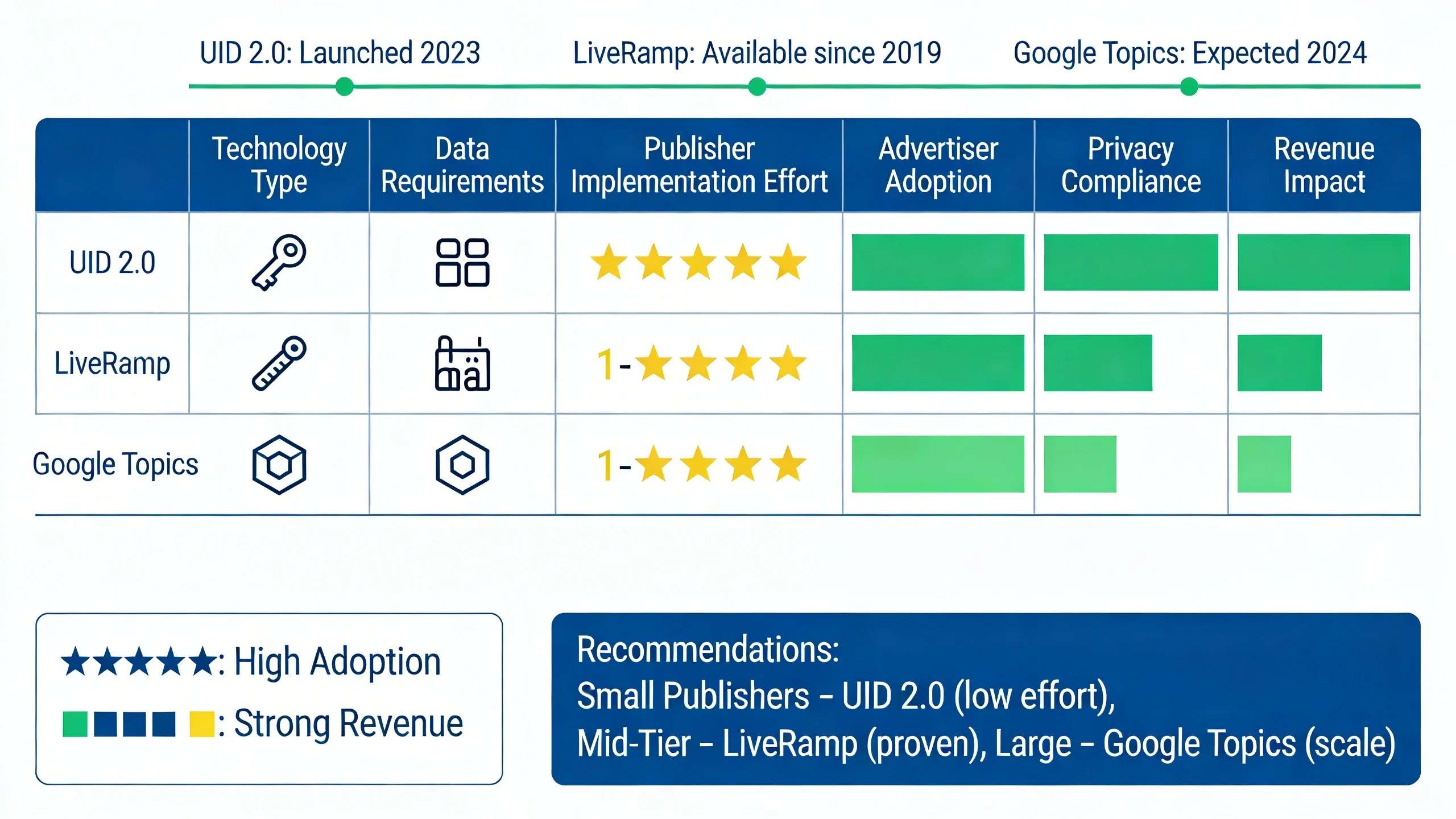
For publishers, the impact is direct and severe. The primary consequences include:
- Loss of Addressability: The inability to recognize and target users across different sites.
- Lower CPMs: Without identity, ad inventory is perceived as less valuable, driving down prices.
- Broken Measurement and Attribution: Difficulty in proving campaign effectiveness and attributing conversions.
In short, the very foundation of ad monetization as we knew it has cracked, forcing the industry to build something better in its place.
Part 3: The New Identity Landscape: A Taxonomy of Solutions
As the cookie crumbles, a new ecosystem of solutions has risen from the rubble. While the landscape can seem fragmented and confusing, most approaches fall into one of four main categories. Understanding these buckets is the first step to building a coherent strategy.
- Universal IDs (Identifier-Based Solutions): This is the primary focus of the post-cookie conversation. The core concept is to create a shared, privacy-conscious identifier to replace the cookie. These IDs are typically created from first-party data (like a hashed email address) and allow for addressable advertising to continue in a more transparent and consensual manner. We will dive deep into these solutions shortly.
- Google's Privacy Sandbox (Walled Garden Cohorts): As the owner of the world's largest browser, Google is building its own set of solutions. The Privacy Sandbox aims to keep user data within the Chrome browser, replacing individual tracking with cohort-based targeting through APIs like the Topics API and Protected Audience (formerly FLEDGE). This is a critical piece of the puzzle, but it represents a "walled garden" approach that limits data portability.
- Contextual Advertising (The Resurgence): This is a "back-to-basics" approach that predates the cookie. Instead of targeting the user, contextual advertising targets the content of the page. Advanced AI and natural language processing (NLP) have made this method far more sophisticated than its predecessor. While highly privacy-safe, most in the industry view contextual as a powerful complementary strategy, not a complete replacement for user-level addressability.
- First-Party Data Activation (The Foundation): This isn't a standalone solution but the bedrock upon which all other successful strategies are built. In the new world, publishers who can collect, manage, and activate their own first-party data hold the power. This data, gathered directly and with consent from your audience, is the fuel for Universal IDs and the key to building direct relationships with advertisers.
Part 4: Deep Dive: Universal ID Solutions Compared
Universal IDs are the leading contenders to restore addressability across the open internet. Before comparing them, it's crucial to understand a key distinction:
- Deterministic Matching: This method links devices and users based on personally identifiable information (PII) that has been anonymized (hashed and encrypted), such as an email address or phone number. It's highly accurate because it's based on a known, user-provided data point.
- Probabilistic Matching: This method uses algorithms to infer a user's identity based on a combination of non-PII signals, like IP address, device type, browser version, and browsing patterns. It's less accurate but can provide greater scale.
The most prominent universal ID solutions today are primarily deterministic, as they are built for a privacy-first world that requires user consent.
---
A. Unified ID 2.0 (UID 2.0)
- Who's Behind It: Initially developed by The Trade Desk (TTD), UID 2.0 is now an open-source industry initiative managed by the IAB Tech Lab.
- How It Works: UID 2.0 operates on the principle of a clear value exchange. A user provides their email address or phone number to a publisher (e.g., by logging in or subscribing to a newsletter). This PII is then hashed and encrypted to create a UID 2.0 identifier. This anonymized ID is passed into the bid stream, allowing advertisers to bid on a known (but not personally identifiable) user without relying on a third-party cookie.
- Pros for Publishers:
* Open-Source & Interoperable: Designed to be a common currency for the open internet, not controlled by a single entity.
* User Control: Includes transparency and consent mechanisms, aligning with privacy regulations.
* Higher Value: Authenticated traffic is inherently more valuable, potentially leading to higher CPMs for publishers who can drive user logins.
- Cons/Considerations:
* Authentication Dependent: Its effectiveness is directly tied to a publisher's ability to convince users to log in. This can be a significant challenge for publishers without a natural registration model.
* Ecosystem Adoption: Its ultimate success hinges on widespread adoption by publishers, SSPs, DSPs, and advertisers.
B. LiveRamp's RampID
- Who's Behind It: LiveRamp, a major data connectivity platform.
- How It Works: LiveRamp’s Authenticated Traffic Solution (ATS) allows publishers to connect their first-party user data to LiveRamp's RampID, a person-based, omnichannel identifier. RampID is built from a massive identity graph that connects both online and offline data points. When a user authenticates on a publisher's site, ATS helps resolve that user to a RampID in real-time, making the inventory addressable for advertisers in the ecosystem.
- Pros for Publishers:
* Massive Scale: LiveRamp has one of the largest and most established identity graphs in the industry, with deep integrations across the ad-tech ecosystem.
* Omnichannel: Connects digital behavior with offline data, providing a richer profile for advertisers.
* Enterprise-Ready: A trusted solution used by many of the world's largest brands and agencies.
- Cons/Considerations:
* "Walled Garden" Perception: While it operates on the open web, some view LiveRamp's proprietary graph as a form of a walled garden.
* Cost: Implementation may involve higher costs compared to some open-source alternatives.
C. ID5 Universal ID
- Who's Behind It: ID5, a company positioning itself as a neutral and independent identity infrastructure provider.
- How It Works: The ID5 ID is designed to maximize addressability across all environments. It intelligently uses a mix of signals. When a deterministic identifier (like a hashed email) is available, it uses that for high accuracy. For unauthenticated users where such data isn't available, it can leverage probabilistic signals to still provide an ID, increasing the overall addressable audience for a publisher.
- Pros for Publishers:
* Neutrality: As an independent provider not owned by a major buyer (like TTD) or data company (like LiveRamp), it offers a neutral solution.
* Maximum Reach: The hybrid deterministic/probabilistic approach helps monetize a wider spectrum of traffic, not just authenticated users.
* Privacy-Focused: Built with privacy compliance like GDPR in mind, offering features like signal encryption and robust consent management integrations.
- Cons/Considerations:
* Adoption is Key: Like all universal IDs, its value is directly proportional to its adoption rate among buyers and sellers in the ad-tech chain.
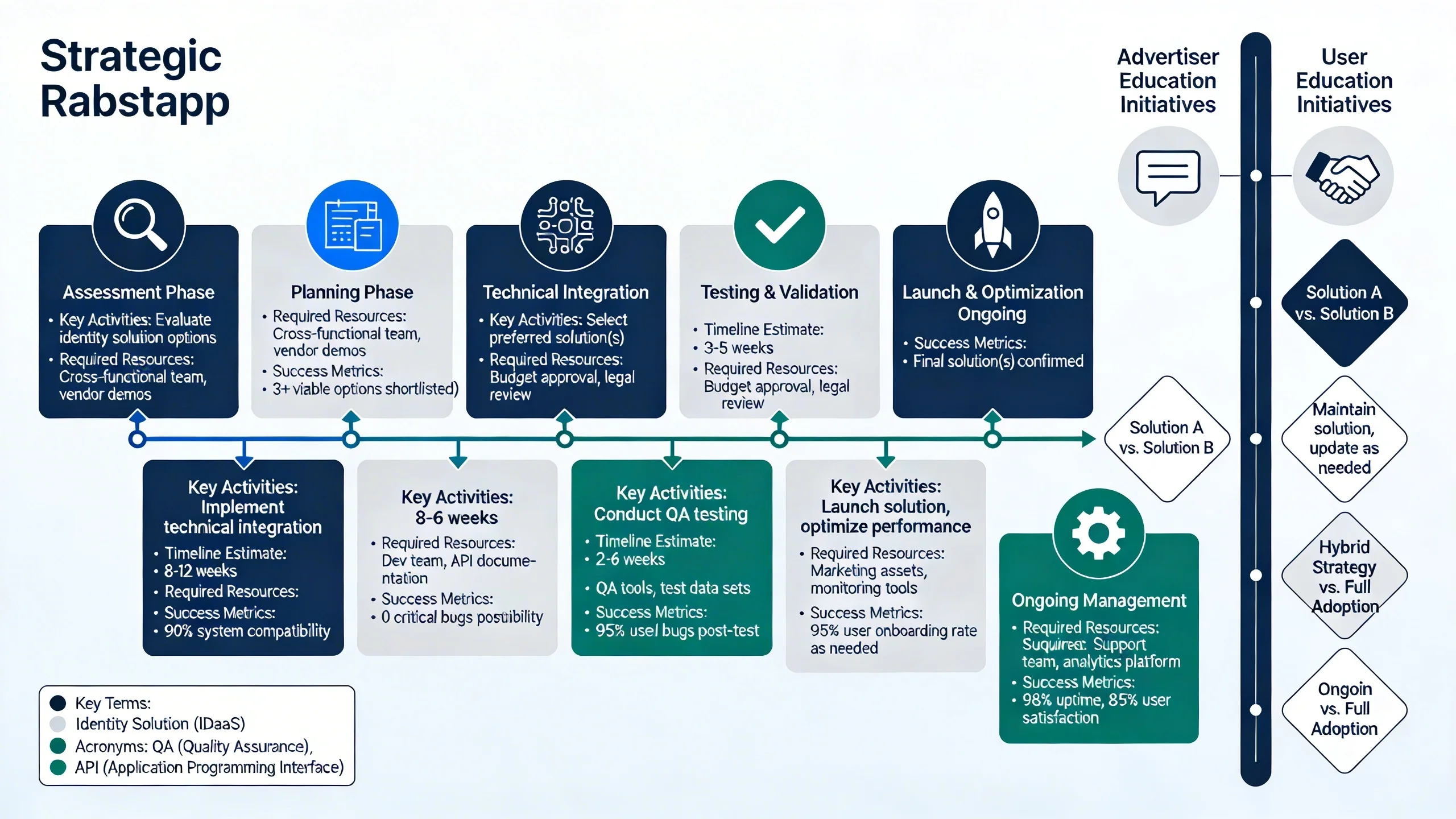
| Feature | Unified ID 2.0 (UID 2.0) | LiveRamp RampID | ID5 Universal ID |
|---|---|---|---|
| Basis | Deterministic (Hashed Email/Phone) | Deterministic (Authenticated Data) | Hybrid (Deterministic & Probabilistic) |
| Key Pro | Open-source, interoperable standard | Massive scale and deep enterprise adoption | Neutrality and maximized reach across all users |
| Key Consideration | Heavily reliant on publisher authentication strategy | Proprietary graph, potential cost | Scale is dependent on broad ecosystem adoption |
Part 5: The Publisher's Playbook: A 4-Step Strategy for the Cookieless Future
Understanding the landscape is one thing; acting on it is another. Publishers need a clear, actionable plan to transition effectively. Here is a four-step playbook to not only adapt but to build a more resilient and profitable business.
Step 1: Audit and Fortify Your First-Party Data Strategy.
Your first-party data is your most valuable asset in the post-cookie world. It's time to treat it that way. This goes beyond simply having a newsletter signup form.
- Audit Your Collection Points: Where and how are you collecting data? This includes site registrations, newsletter sign-ups, comments, polls, surveys, and content gating.
- Establish a Clear Value Exchange: Users are savvy about their data. They won't give you their email address for free. You must offer a compelling reason. This could be exclusive content, a premium ad-free experience, personalized recommendations, or early access to articles. Communicate this value clearly and consistently.
- Centralize and Organize: Ensure all this valuable data flows into a central system, like a Customer Data Platform (CDP), where it can be segmented and prepared for activation. A strong publisher first-party data strategy is non-negotiable.
Step 2: Develop a Robust Authentication Strategy.
As we've seen, the most powerful deterministic ID solutions like UID 2.0 and LiveRamp's ATS are fueled by authenticated users. Your ability to drive logins is directly correlated with your ability to generate high-value, addressable inventory.
- Analyze User Experience: A clunky, intrusive login process will kill adoption. Make it as seamless as possible, potentially offering social logins (e.g., "Login with Google") to reduce friction.
- Consider Soft vs. Hard Registration Walls: A hard wall (requiring login to access any content) can work for highly specialized or premium content but may alienate casual visitors. A soft wall, which prompts registration after a certain number of articles or for specific features, is often a more balanced approach. Test to see what works for your audience.
Step 3: Test and Diversify Your Identity Partners.
There will likely not be a single "winner" that replaces the cookie. The future is about interoperability. Therefore, putting all your eggs in one basket is a risky strategy.
- Don't Go All-In Immediately: The landscape is still evolving. The smart move is to test multiple universal ID solutions simultaneously.
- Collaborate with Your Partners: Work closely with your SSPs and other ad-tech vendors. They are on the front lines of this transition and can provide invaluable data on which identity solutions are driving demand and performance for your specific inventory. Run A/B tests to see which combinations of IDs yield the highest CPMs. The answer may vary depending on geography and audience type.
Step 4: Re-evaluate Your Tech Stack.
The technology that powered your business in the cookie era may not be fit for purpose in the new one. A thorough tech audit is essential.
- Consent Management Platform (CMP): Is your CMP robust enough to handle the complex consent strings required by new regulations and ID solutions? It must be able to clearly capture, store, and pass user consent signals downstream.
- Customer Data Platform (CDP): Does your CDP have pre-built integrations with the major identity solutions? Its ability to seamlessly connect your first-party data to platforms like UID 2.0 or LiveRamp is critical for efficient activation.
Part 6: Choosing the Right Partner: What to Look for in an Identity Solution
As you evaluate the crowded field of cookieless advertising solutions, it can be difficult to separate the signal from the noise. The right partner isn't just a piece of technology; they are a strategic asset that empowers you to take control of your future. Use this expert checklist to guide your decision.
- ✅ Privacy-First by Design: Does the solution place user privacy and consent at its absolute core, or is it an afterthought? It should be built to exceed the requirements of GDPR and CCPA, not just meet the bare minimum.
- ✅ Publisher Control & Transparency: Do you, the publisher, own the data and the identity graph built from it? You need clear, transparent insights into how your data is being used and the ability to control it at all times. Avoid "black box" solutions.
- ✅ Interoperability: Does the solution work seamlessly with your existing ad-tech stack? It should be vendor-agnostic and easily integrate with the SSPs, DSPs, and DMPs you already trust.
- ✅ Ease of Implementation: How much technical lift and engineering resources are required to get started? The best solutions provide lightweight, flexible integration paths to ensure a fast time-to-value.
- ✅ Future-Proof & Scalable: Is the solution adaptable? It must be engineered to evolve with future regulatory changes and browser updates, ensuring your monetization strategy remains resilient for years to come.
IMC's identity solution was built from the ground up to meet these criteria, giving publishers the control and technology needed to thrive. Learn how IMC can future-proof your revenue. Contact us for a demo
Part 7: Conclusion - The Future is Addressable
The end of the third-party cookie represents a fundamental reset for the digital advertising industry. While the transition brings challenges, it ultimately clears the path for a better, more equitable internet. The cookie is gone, but addressability is not. Publishers who proactively embrace a first-party data and privacy-centric identity strategy are in the strongest possible position. By taking control of your audience relationships and choosing the right technology partners, you can build a more sustainable, transparent, and valuable business for the future.
Part 8: FAQ Section
Q1: What will replace third-party cookies for publishers?
A: There isn't one single replacement. Instead, a combination of solutions will be used. The main categories are: 1) Universal ID solutions (like UID 2.0, LiveRamp RampID, and ID5) that use first-party data to create a new identifier, 2) Google's Privacy Sandbox which uses cohort-based targeting, and 3) Enhanced contextual advertising. A publisher's strategy will likely involve all three.
Q2: Is UID 2.0 a good solution for all publishers?
A: UID 2.0 is a powerful solution, but its effectiveness depends heavily on a publisher's ability to get users to log in or provide an email address. For publishers with strong subscription models or membership programs, it's an excellent fit. For those with mostly anonymous, transient traffic, its impact will be limited unless they develop a strong authentication strategy.
Q3: How is Google's Privacy Sandbox different from Universal IDs?
A: The key difference is control and data portability. Universal IDs aim to create an interoperable identifier that works across the open internet, allowing publishers and advertisers to transact using a common currency. Google's Privacy Sandbox is designed to keep user data within the Chrome ecosystem, replacing individual targeting with anonymous, browser-managed interest groups (Topics). It's a "walled garden" approach versus an "open web" approach.
Q4: How can I increase the number of authenticated users on my site?
A: The key is offering a clear and compelling "value exchange." Users need a reason to sign up. This can include offering exclusive content, a better user experience (e.g., fewer ads), personalization features, the ability to save articles, or community features like commenting. Making the registration process as seamless as possible using social logins and a clean UI is also critical.