
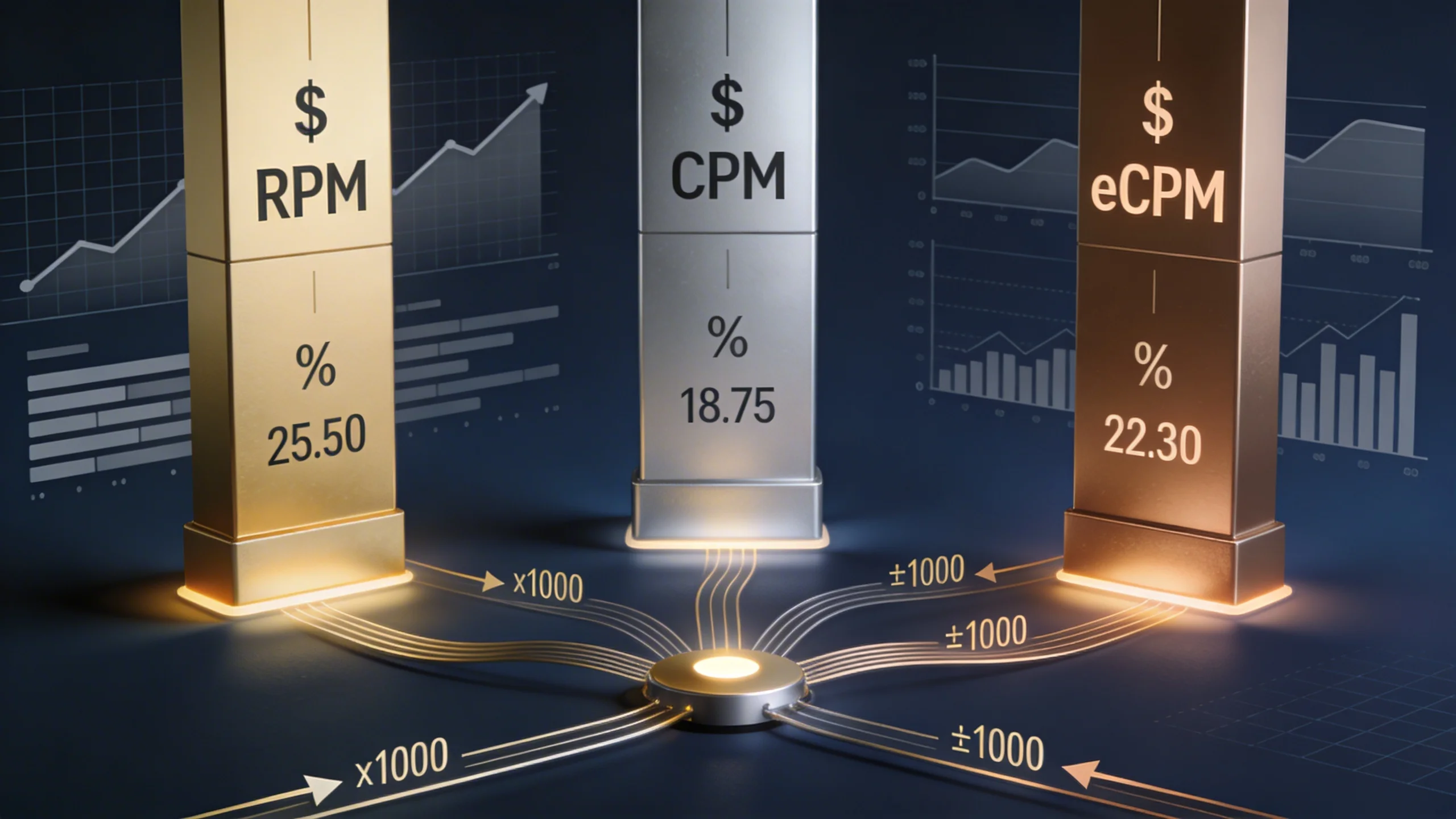
The Foundation: What is CPM (Cost Per Mille)? The Advertiser's Price Tag
Understanding the Advertiser's Perspective
Before you can understand your own earnings, you must first understand the advertiser's costs. This is where CPM comes in.
CPM stands for "Cost Per Mille," with "mille" being Latin for a thousand. It is the price an advertiser agrees to pay for their ad to be shown 1,000 times on a website. It is the most common currency for buying and selling digital ad inventory.
The formula from the advertiser's point of view is simple:
CPM = (Total Ad Spend / Total Ad Impressions) * 1000
Think of CPM as the "sticker price" for your ad space. When an advertiser sees that your website commands a $15 CPM, they know that it will cost them $15 for every 1,000 times their ad is loaded on your pages. It’s a straightforward metric that allows them to budget and compare advertising costs across different websites and platforms.
For you, the publisher, a high CPM is a great signal. It means advertisers value your audience and are willing to pay a premium to reach them. Niches like finance, law, and technology often command higher CPMs because the potential value of a customer is extremely high.
However, and this is the most critical point, CPM has a major limitation for publishers: it tells you nothing about your actual earnings. It is an advertiser-centric metric. A high CPM is meaningless if those ads are never served due to low fill rates or are placed where no one sees them. It's just one piece of a much larger puzzle.
The Publisher's North Star: What is RPM (Revenue Per Mille)? Your True Earnings Power
Measuring the Health of Your Pages and Your Business
If CPM is the advertiser's metric, then RPM is the publisher's metric. This is the number that should command your attention when evaluating the overall financial health of your website.
RPM stands for "Revenue Per Mille." While there are different types of RPM, the most important one is Page RPM. It represents your total estimated earnings for every 1,000 pageviews your site receives. It answers the fundamental question: "For every 1,000 visitors who view a page, how much money do I make?"
The formula for Page RPM is:
Page RPM = (Total Estimated Earnings / Total Number of Pageviews) * 1000
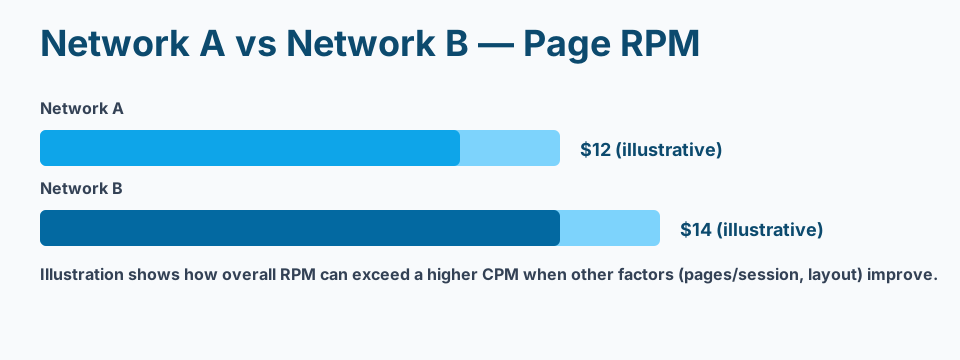
The key distinction here is crucial for your understanding: RPM is calculated based on pageviews, while CPM is based on ad impressions. This is not just a semantic difference; it's a fundamental shift in perspective. A single pageview can generate multiple ad impressions—one in the header, one in the sidebar, one within the content, and so on.
This is precisely why Page RPM is a superior metric for publishers. It provides a holistic view of your monetization performance. RPM automatically factors in multiple critical variables that CPM ignores:
- CPM Rates: The "sticker price" of your ad units.
- Fill Rate: The percentage of ad requests that are actually filled with a paying ad.
- Ad Density: The number of ad units on your page.
- Performance Models: It rolls up revenue from all sources, including CPM, CPC (Cost Per Click), and others.
Because it encompasses all these factors, Page RPM gives you actionable insight. If you add a new sticky footer ad unit and your Page RPM increases from $15 to $18, you've made a good decision. If you switch to a new ad layout and your RPM drops, you know it's time to revert. It's a direct measure of your monetization efficiency on a per-pageview basis.
While Page RPM is your go-to metric, it’s also worth knowing about Session RPM. This metric calculates your revenue per 1,000 user sessions. It’s a higher-level metric that helps you understand the total value of a visitor's entire journey on your site, which is especially useful if you have a site where users visit multiple pages per session.
The Great Equalizer: What is eCPM (Effective Cost Per Mille)? Comparing Apples to Oranges
How to Standardize Performance Across All Ad Types
Now we introduce the third acronym: eCPM. At first glance, it looks confusingly similar to CPM. However, its purpose is entirely different.
eCPM stands for "Effective Cost Per Mille." It is a publisher-side performance metric that calculates the revenue you generated per 1,000 ad impressions, regardless of the buying model.
The formula for eCPM is:
eCPM = (Total Earnings / Total Ad Impressions) * 1000
Wait, that looks almost identical to the CPM formula! What’s the difference? The key is in the "Effective" part. While CPM is a pre-agreed price, eCPM is a post-campaign calculation of performance.
The primary purpose of eCPM is to help you compare revenue from different types of ad campaigns and ad units on an apples-to-apples basis.
Imagine you have two ad units on your page:
- Ad Unit A is sold to an advertiser on a direct CPM basis.
- Ad Unit B is running ads from a network that pays you on a CPC (Cost Per Click) basis.
How do you know which unit is performing better? You can't directly compare a CPM rate to CPC earnings. This is where eCPM becomes your translator. By calculating the eCPM for both units, you convert all earnings into a universal language: revenue per 1,000 impressions.
An analogy helps here: think of eCPM as converting different currencies (CPM, CPC, CPA) into a single, standard currency (like the US Dollar) to make a fair comparison.
For a campaign sold on a pure CPM basis, the CPM and eCPM will be the same. The "effective" part becomes critical when you're dealing with performance-based models like CPC or CPA, allowing you to see how they stack up against your standard CPM inventory.
At a Glance: RPM vs. CPM vs. eCPM Comparison Table
To make these distinctions crystal clear, here’s a simple table that summarizes the key differences. This is a great cheat sheet to bookmark.
| Metric | What It Measures | Perspective | Formula | Primary Use Case for Publishers |
|---|---|---|---|---|
| CPM | The cost an advertiser pays per 1,000 impressions. | Advertiser | (Cost / Impressions) * 1000 | Understanding the market value of your ad inventory. |
| RPM | The total revenue you earn per 1,000 pageviews. | Publisher | (Earnings / Pageviews) * 1000 | Measuring the overall monetization health of your website/pages. |
| eCPM | The effective revenue earned per 1,000 impressions. | Publisher | (Earnings / Impressions) * 1000 | Comparing the performance of different ad units/networks/campaigns. |
What Really Matters: Moving from Metrics to Maximizing Revenue
We’ve defined the terms, but the most important question remains: what should you actually do with this information?
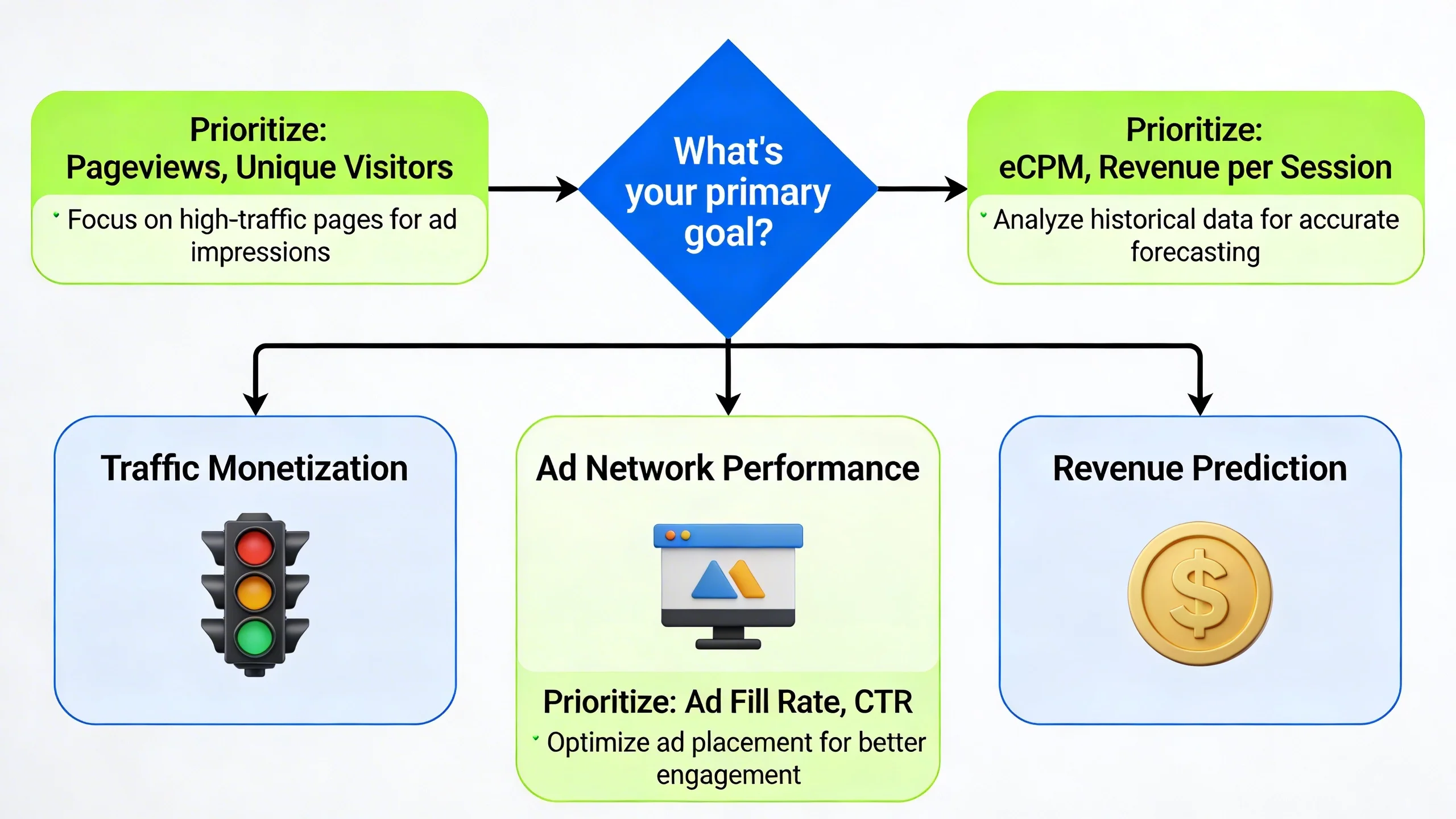
Here is the verdict: Your "North Star" metric should be Page RPM for monitoring the high-level health of your monetization strategy. Your ultimate goal is always Total Revenue. And you should use eCPM for granular, diagnostic analysis of individual ad units, ad partners, and A/B tests.
The most common and costly mistake publishers make is chasing a high CPM above all else. A single ad network might promise you an incredible $20 CPM, which sounds fantastic. But this can easily lead to lower overall revenue.
Let's illustrate with a classic hypothetical example. You have to choose between two ad networks to fill a specific ad slot:
- Network A: Promises a very high $10 CPM. However, they only have ads for a small segment of your audience, resulting in a low 20% Fill Rate.
- Network B: Offers a more modest $4 CPM. But they have a massive pool of advertisers, resulting in a high 90% Fill Rate.
If you only look at CPM, Network A seems like the clear winner. But let's calculate the effective revenue (eCPM):
- Network A eCPM: $10 * 20% = $2.00
- Network B eCPM: $4 * 90% = $3.60
Suddenly, the picture is completely different. Network B, despite its lower "sticker price" CPM, will actually make you significantly more money. This is a conclusion you can only reach by looking at effective earnings (eCPM and, by extension, RPM), not just the headline CPM.
Levers You Can Actually Pull to Increase Revenue
Understanding these metrics empowers you to focus on the levers that will genuinely grow your business.
To Influence CPMs:
While you don't control advertiser budgets, you can make your inventory more valuable by:
- Improving Content Quality: Authoritative, engaging content attracts a high-value audience.
- Growing High-Value Audience Segments: Traffic from tier-1 geographies (US, UK, CA) and desirable demographics commands higher prices.
- Enhancing Ad Viewability: Ensure your ads are actually seen by users.
- Working with Premium Demand Partners: Connect with networks and exchanges that represent top-tier brands.
To Influence RPMs (The Most Important Levers):
This is where you have the most control and can see the biggest impact on your total revenue.
- Optimize Ad Layout & Density: Experiment with the number and placement of ad units to find the sweet spot between revenue and user experience (UX).
- Improve Fill Rate: Don't leave money on the table. Solutions like header bidding create an auction where multiple demand partners bid on your inventory simultaneously, dramatically increasing fill rate and competition.
- Increase Ad Viewability: Implement strategies like sticky ads (ads that stay in view as the user scrolls) and lazy loading (loading ads only as they enter the viewport).
- Improve Site Speed and Core Web Vitals: A faster, smoother site leads to a better user experience, which means more pageviews per session and higher ad engagement.
- Leverage Multiple Ad Formats: Diversify your ad stack with a mix of display, video, and native ads to appeal to a wider range of advertisers and campaigns.
Beyond the Big Three: Other Metrics in Your Arsenal
While RPM, CPM, and eCPM are the main event, a few other supporting metrics provide crucial context:
- Fill Rate: The percentage of ad requests that result in an ad being served. A low fill rate is a clear sign you're missing out on revenue.
- Viewability: Defined by the IAB as at least 50% of an ad's pixels being in view for at least one continuous second. Higher viewability directly leads to higher CPMs.
- CTR (Click-Through Rate): The percentage of impressions that result in a click. This is critically important for diagnosing the performance of CPC-based campaigns.
Frequently Asked Questions (FAQ)
What is a "good" Page RPM?
This is one of the most common questions, and the honest answer is: it depends. A "good" RPM varies dramatically by niche, audience geography, traffic source, and seasonality. A lifestyle or hobby blog might see a Page RPM of $5-$15. A highly specialized finance or tech blog with a US-based audience could command an RPM of $25-$50 or even higher. The best benchmark is your own historical performance.
Why did my RPM suddenly drop?
A sudden drop in RPM can be alarming, but it's usually explainable. The most common culprits are:
- Seasonality: Ad spend is cyclical. It peaks in Q4 (holiday season) and typically drops sharply in January (Q1).
- Changes in Traffic Source: Traffic from social media or discovery platforms often has a lower RPM than traffic from organic search.
- A Drop in Viewability: A recent site redesign could have pushed ads "below the fold," hurting their viewability and value.
- Technical Issues: A misconfigured
ads.txtfile or other on-site errors can prevent advertisers from bidding on your inventory.
Can I have a high CPM but a low RPM?
Absolutely. This is a classic scenario that highlights the importance of looking beyond CPM. It typically means you have high-value ad inventory (a high CPM "sticker price") but are failing to monetize it effectively. The most common reasons are a very low fill rate (you aren't getting bids for most of your ad requests) or having too few ad units on the page, leading to low overall earnings per pageview (low RPM).
Conclusion
Navigating the world of ad monetization can feel like swimming in an alphabet soup of metrics. But by understanding the distinct roles of CPM, eCPM, and RPM, you can gain clarity and control over your revenue strategy.
Let's recap the key takeaways:
- CPM is the advertiser's price tag for 1,000 impressions.
- eCPM is your diagnostic tool for making apples-to-apples comparisons between different ad units and partners.
- Page RPM is your holistic measure of monetization health, your true north star.
Ultimately, your goal is to grow your Total Revenue, and the most effective path to that goal is by focusing on strategies that consistently increase your Page RPM. Stop chasing high CPMs from a single source and start building a comprehensive strategy that optimizes your entire ad stack.
Optimizing your ad layout, fill rate, viewability, and demand partners to improve RPM without sacrificing user experience is a full-time job. At IMC, our technology automates this complex process, using advanced header bidding and machine learning to ensure you're always maximizing your revenue from every single pageview.
Schedule a free consultation today to see how our platform can analyze your current setup and boost your bottom line.