
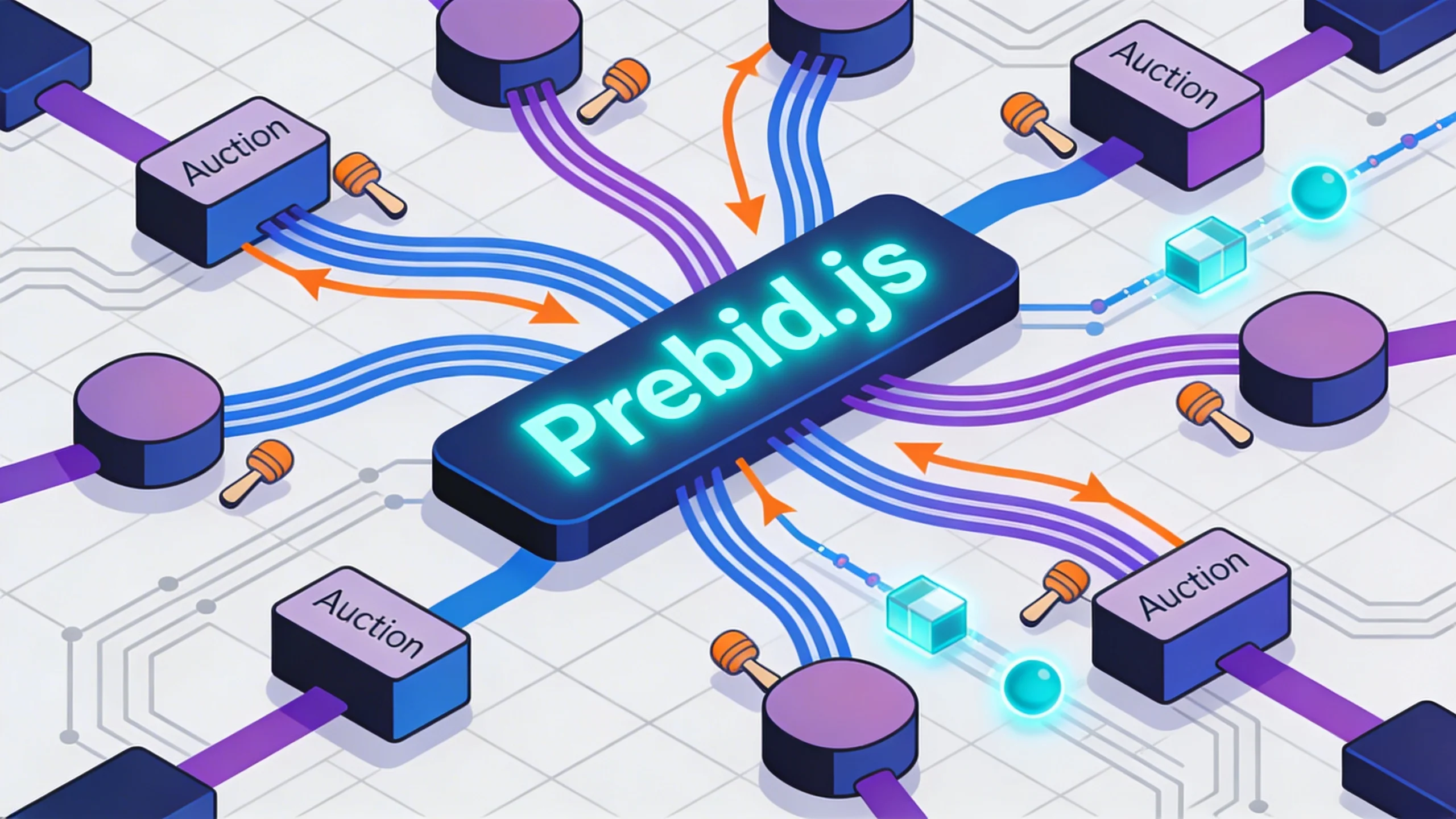
Before Prebid: The Problem with the Waterfall Method
To understand why Prebid.js is so revolutionary, we first need to look at the problem it solved: the ad serving waterfall. For years, this was the standard way publishers filled their ad inventory.
Imagine your ad space is a valuable item up for sale. In a waterfall setup, you offer it to potential buyers one by one, in a predetermined order. The first partner gets "first dibs." If they don't want it or don't bid high enough, you go to the next partner in line, and so on.
This "first-dibs" system has two major flaws:
- Inefficiency: It's slow and sequential. Each partner in the chain adds a little bit of delay.
- Lost Revenue: The biggest flaw is that a high-paying bidder at the bottom of the chain might never even get a chance to bid. If a partner at the top places a low bid of $1.00, you have to accept it, even if a partner at the bottom was willing to pay $5.00. You'd never know.
This method regularly left significant revenue on the table and lacked any real transparency into the true value of a publisher's inventory.
Visual Aid Recommendation: A simple diagram showing a sequential, step-by-step "waterfall" on one side, and a simultaneous, "all-at-once" auction for header bidding on the other.
The Solution: What is Header Bidding?
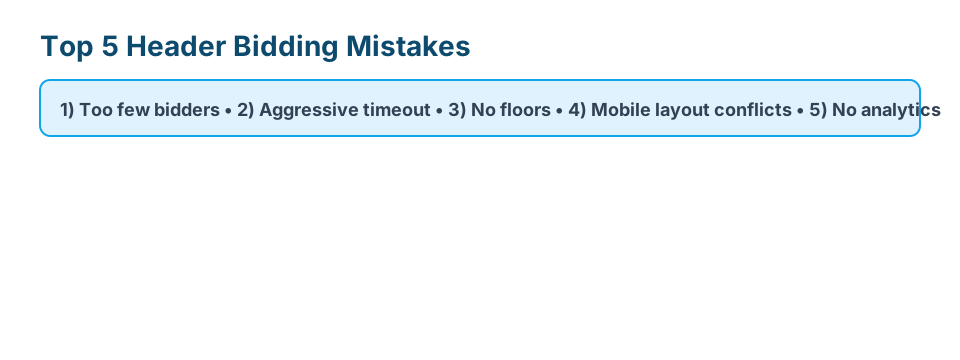
Header bidding flips the waterfall model on its head.
Instead of a one-by-one sequential chain, header bidding is a unified auction. It allows you to offer your ad inventory to all your demand partners at the same time, before making a call to your primary ad server.
Think of it like a silent auction where every interested buyer places their best bid simultaneously. You simply look at all the bids and identify the highest one. This creates a fair, hyper-competitive environment that forces demand partners to bid their true highest price for your inventory. The result? A dramatic increase in your yield and average CPMs.
So, What is Prebid.js and Why is it So Popular?
Now that you understand the concept of header bidding, let's zoom in on the technology that makes it possible for thousands of publishers worldwide: Prebid.js.
Prebid.js is a "Wrapper"
In simple terms, Prebid.js is a header bidding wrapper. Think of the wrapper as the "project manager" or "auctioneer" for your header bidding auction. It's a JavaScript container that you place in the header of your website. Its job is to:
- Organize the auction.
- Send out bid requests to all your demand partners.
- Collect the bids that come back.
- Enforce the rules (like timeouts).
- Identify the winner.
- Send that winning bid to your ad server to compete.
Without a wrapper, you would have to manually code connections and manage relationships with every single demand partner, a process that would be impossibly messy and inefficient. Prebid.js standardizes and streamlines everything.
Prebid.js is Open-Source and Free
One of the biggest reasons for Prebid's dominance is that it is completely open-source. This means the code is publicly available for anyone to view, use, and contribute to. Unlike proprietary, "black box" solutions where you can't see what's happening under the hood, Prebid offers:
- Transparency: You can see exactly how the auction logic works.
- Flexibility: You can customize it to fit your exact needs.
- Trust: You know there are no hidden fees or secret manipulations of the auction.
- Cost-Effectiveness: The software itself is free to use.
Prebid.js is a Community
Prebid isn't just a piece of code; it's a massive, independent community managed by Prebid.org. It’s supported by hundreds of developers and ad tech companies who contribute their expertise to continuously improve the product, fix bugs, and keep it the industry standard. This collaborative effort ensures Prebid remains innovative, stable, and trusted by the entire digital advertising ecosystem.
How Prebid.js Works: A Step-by-Step Breakdown
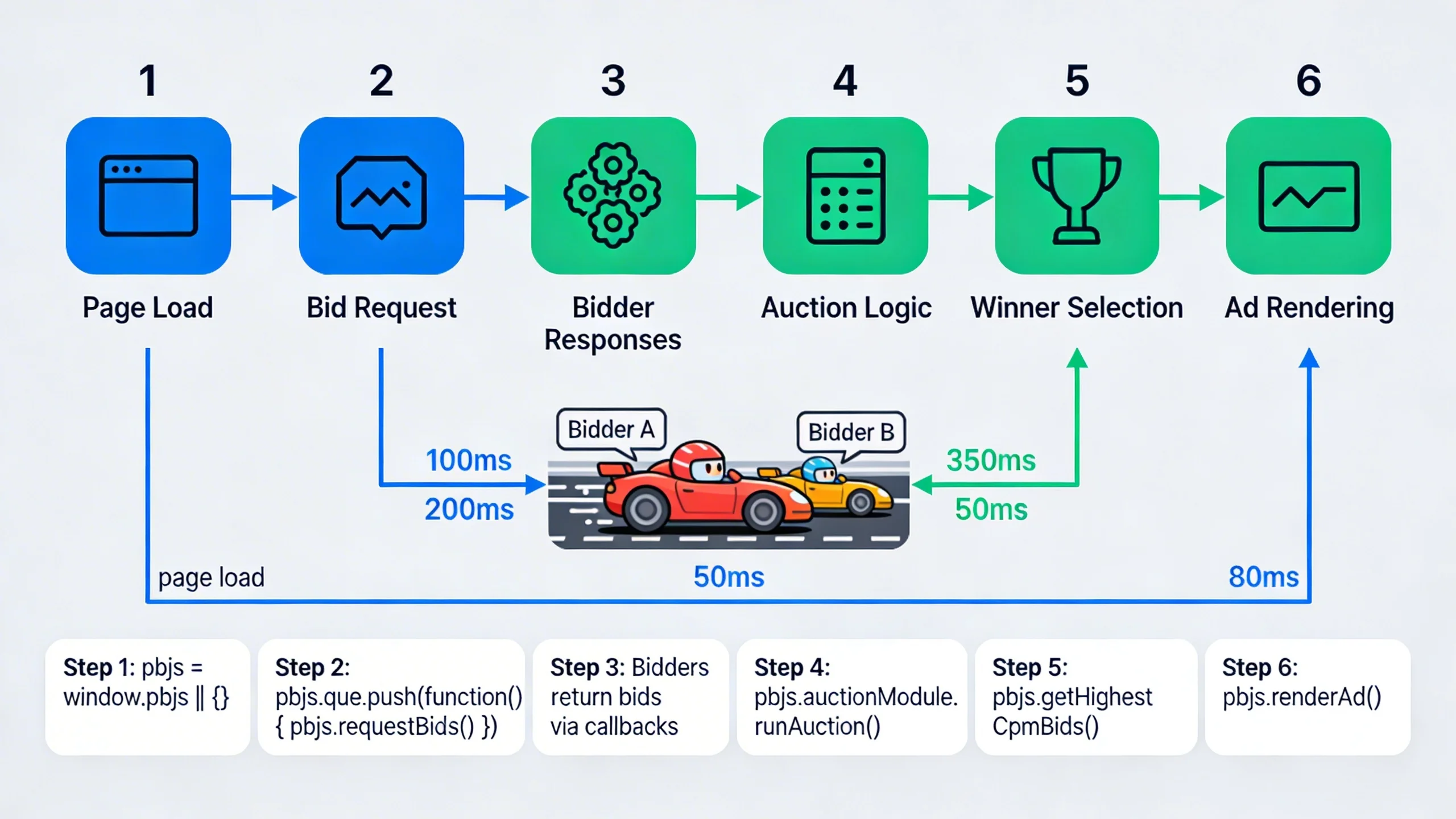
This is where the magic happens. While the underlying technology is complex, the process can be broken down into six simple steps.
- The Request: A user visits your webpage. As the page begins to load, the Prebid.js library in the site's header loads, too.
- The Call-Out: The library immediately sends out bid requests simultaneously to all the demand partners you've configured (like SSPs and ad exchanges).
- The Bids: These demand partners have a very short, predefined window (a timeout, often around 400-800ms) to respond with their bids, which are expressed as CPMs (Cost Per Mille, or cost per thousand impressions).
- The Auction: Once the timeout is reached, Prebid.js gathers all the bids that came back in time. It analyzes them and determines the single highest bidder from the auction.
- The Handoff: Prebid.js doesn't serve the ad itself. Instead, it passes the winning bid information (the price and the creative) as key-value pairs to your main ad server, which is usually Google Ad Manager (GAM).
- The Final Decision: Your ad server now holds the winning Prebid bid. It compares this bid against all other demand sources it manages, such as direct-sold campaigns, its own exchange (Google AdX), or other ad networks. It then serves the creative from whichever source offers the absolute highest price, guaranteeing maximum yield for that impression.
Visual Aid Recommendation: A detailed flowchart diagram illustrating these 6 steps, with icons for the user, website, Prebid.js, SSPs, and Google Ad Manager.
The Core Benefits of Using Prebid.js for Publishers
Translating the technical features into business value, here’s what Prebid.js delivers for publishers like you:
- Increased Revenue: This is the number one benefit. By creating a unified auction with more competition, you drive up bid density and, consequently, your CPMs and overall ad revenue.
- Unparalleled Transparency: With open-source code, you can see everything. You know exactly which partners are bidding, how much they’re bidding, and your auction win rates. This data is invaluable for optimizing your monetization strategy.
- Flexibility & Control: Prebid gives you access to hundreds of demand partners through its library of "adapters." You have complete control to choose who you work with, add or remove partners easily, and set your own auction rules. There is no vendor lock-in.
- Community Support: Facing a technical issue? There’s a massive, active community of developers and a wealth of documentation to help you. This collective brainpower means Prebid is constantly evolving and improving.
Key Prebid.js Concepts You Need to Know
As you start your Prebid journey, you'll encounter a few core terms. Here’s a quick primer:
- Ad Units: These are the specific ad slots on your page that you want to monetize via Prebid. Each ad unit is defined by its size (e.g., 728x90 leaderboard, 300x250 medium rectangle) and placement on the page.
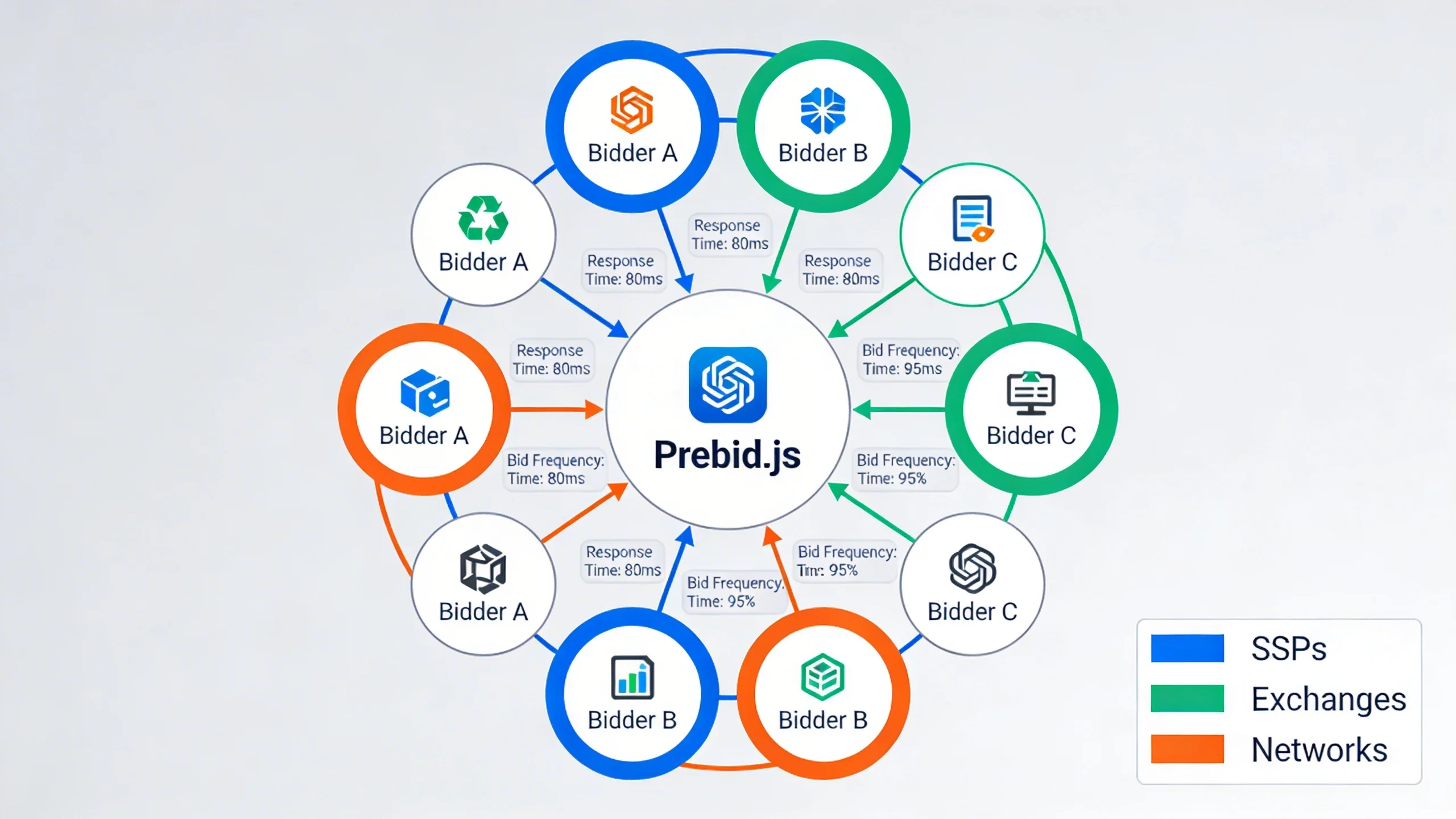
- Bidders & Adapters: A "bidder" is a demand partner (an SSP or ad exchange) that wants to bid on your inventory. An "adapter" is the piece of code that allows that specific bidder to plug into the Prebid.js framework. For every bidder you want to include in your auction, you must include their corresponding adapter in your Prebid setup.
- Timeouts: This is one of the most critical settings in your configuration. It's the maximum amount of time (in milliseconds) you're willing to wait for bidders to return their bids. A longer timeout might mean more bids and higher revenue, but it could also increase page latency. A shorter timeout improves user experience but might exclude slower bidders. Finding the right balance is key.
Prebid.js vs. The Alternatives: Google Open Bidding & Proprietary Wrappers
Prebid.js isn't the only solution on the market. It’s important to understand how it stacks up against the main alternatives.
Prebid.js vs. Google Open Bidding (OB)
Open Bidding (formerly Exchange Bidding) is Google's server-side unified auction product.
- Key Difference: Prebid.js is primarily a client-side solution, meaning the auction runs in the user's browser. Open Bidding is a server-to-server solution, where the auction runs on Google's servers.
- Control: Prebid is open-source and gives you full control and transparency. OB is a Google-managed "black box" product.
- The Hybrid Approach: You don't have to choose. Many sophisticated publishers use both Prebid.js (for client-side demand) and Open Bidding (for server-side demand) to maximize competition and revenue from all possible channels.
Prebid.js vs. Proprietary Wrappers
Some ad tech companies offer their own closed-source, proprietary wrappers.
- Key Difference: The primary trade-off is transparency versus convenience. A proprietary wrapper might offer a fully managed service that's easier to set up, but you lose the transparency, flexibility, and community support of an open-source solution like Prebid. With Prebid, you see everything; with a proprietary wrapper, you are reliant on the vendor's technology and reporting.
Getting Started with Prebid.js: A High-Level Overview
Making the leap to Prebid.js can seem daunting, but the path is well-defined. Here’s a simplified look at the implementation journey:
- Choose Your Path: Decide if you have the in-house development resources to build and manage a Prebid setup yourself (self-serve), or if you'd prefer to partner with a managed Prebid provider who handles the technical complexities for you.
- Select Your Demand Partners: Research and sign contracts with the SSPs and ad exchanges you want to include in your auction.
- Configuration & Setup: This is the most technical step. You'll need to build the Prebid.js file with the correct adapters for your chosen partners and then configure your ad server (Google Ad Manager) with thousands of line items to target the bids.
- Testing & Deployment: Before going live, you must thoroughly test the setup to ensure the auction mechanics are working correctly and that there's no negative impact on site performance or user experience.
The implementation process can be complex. If you want to unlock the benefits of Prebid without the technical headache, our team of experts can manage the entire process for you.
The Future of Prebid: Prebid Server and Beyond
Prebid continues to evolve to meet the industry's needs. The most significant development is Prebid Server, a server-to-server (S2S) version of the technology. Prebid Server moves the auction from the user's browser to an external server. This dramatically reduces the processing load on the user's device, leading to faster page load times and a better user experience, all while preserving a competitive auction.
Furthermore, the Prebid organization is constantly expanding its support for new formats, including robust solutions for Video, AMP (Accelerated Mobile Pages), and Native ads, ensuring it remains the central framework for publisher monetization everywhere.
Conclusion: Why Prebid.js is an Essential Tool for Modern Publishers
Prebid.js is more than just a piece of code; it's the engine of the modern, open internet for publishers. It dismantled the inefficient and opaque waterfall system and replaced it with a fair, transparent, and high-yielding unified auction.
By putting publishers back in control of their ad inventory and fostering a competitive and open marketplace, Prebid.js has become an indispensable tool for anyone serious about maximizing their ad revenue. It empowers you to understand the true value of your audience and ensures you capture every dollar you deserve.
Frequently Asked Questions (FAQ)
Q: Is Prebid a SSP?
A: No, Prebid is not a SSP (Supply-Side Platform). It is a technology framework, or "wrapper," that manages bids from multiple SSPs and ad exchanges in a single, unified auction.
Q: Is Prebid.js free?
A: Yes, the Prebid.js software itself is free and open-source. However, a successful implementation requires dedicated development resources for setup and ongoing maintenance, or a partnership with a managed service provider.
Q: Does Prebid.js slow down your website?
A: It can if not implemented correctly. Factors like the number of bidders and the timeout settings can impact page latency. Using best practices, carefully configured timeouts, and adopting solutions like Prebid Server are crucial to managing and minimizing any performance impact.
Q: How many bidders should I use with Prebid?
A: There's no single magic number, as it depends on your site's traffic and geography. However, most experts recommend starting with 5-8 strong, diverse demand partners to create healthy competition without overwhelming the user's browser and negatively impacting page performance.