

Part 1: The "Why" - Understanding the End of an Era
What Were Third-Party Cookies, and Why Are They Crumbling?
To prepare for the future, we must first understand the past. What exactly were these digital breadcrumbs, and why is their foundation collapsing now?
A Simple Definition for Publishers
In simple terms, a third-party cookie is a small piece of code placed on a user's browser by a domain other than the one they are currently visiting. Its primary function was cross-site tracking. It allowed ad tech platforms to follow a user's journey across the internet, building a detailed profile of their interests, behaviors, and purchase intent. This profile was then used for ad targeting, retargeting (showing ads to previous visitors), and attribution (crediting a sale to a specific ad).
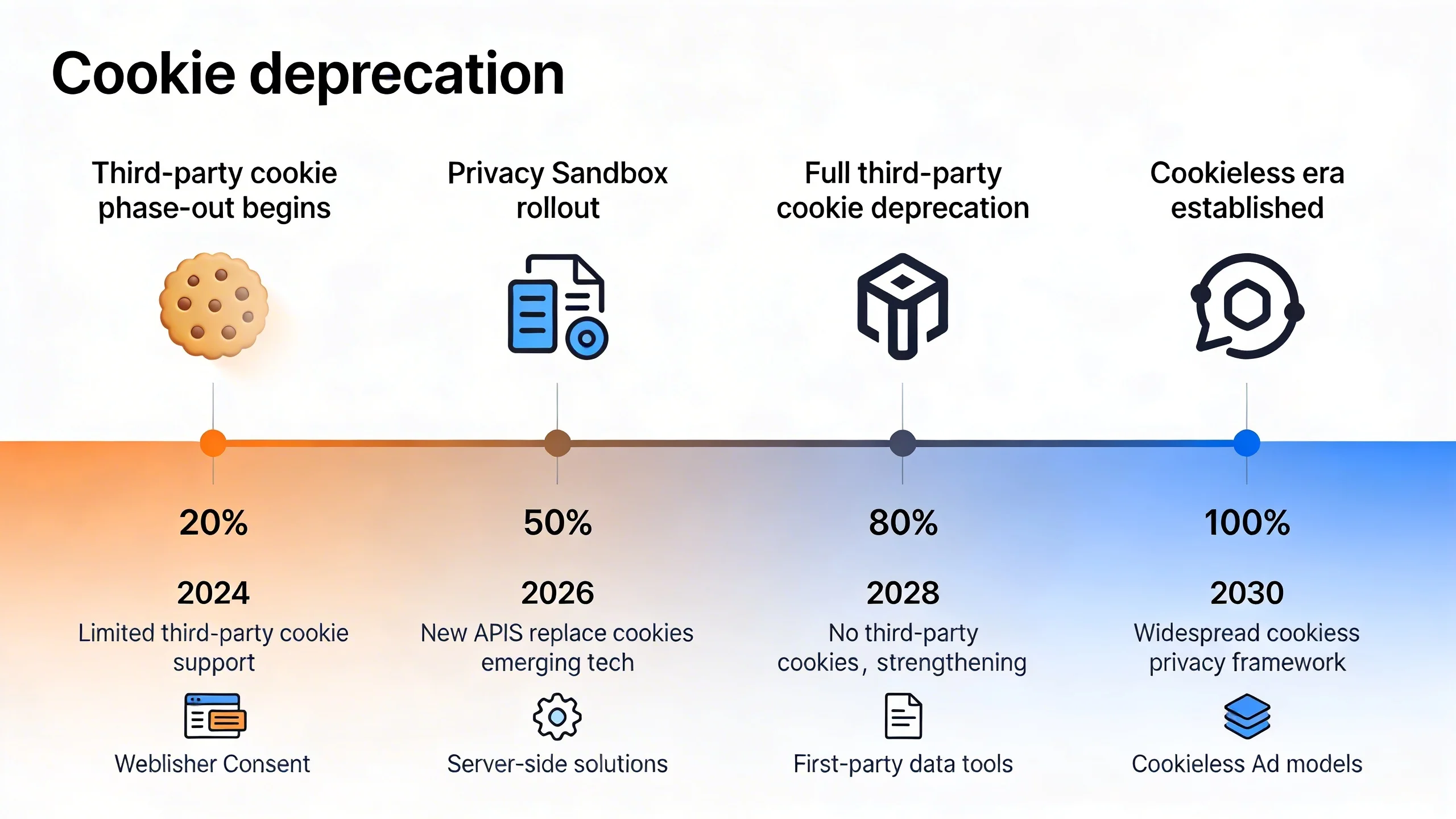
The Three Forces of Deprecation
The demise of the third-party cookie wasn't a single event but the result of a perfect storm of technological, social, and legal pressure.
- User Demand for Privacy: The modern internet user is savvy and skeptical. High-profile data breaches and a growing awareness of digital surveillance have fueled a powerful demand for greater control over personal data. Regulations like Europe's GDPR and the California Consumer Privacy Act (CCPA) are direct legislative responses to this public sentiment.
- Browser Blockades: The tech giants saw the writing on the wall. Apple’s Safari (with Intelligent Tracking Prevention - ITP) and Mozilla’s Firefox (with Enhanced Tracking Protection - ETP) began blocking third-party cookies years ago. Google Chrome, with its dominant market share, is simply the final and most significant player to make the move.
- Regulatory Pressure: Governments worldwide are scrutinizing the ad tech ecosystem. The legal landscape is becoming increasingly hostile to tracking technologies that operate without explicit and clear user consent, making the third-party cookie an untenable liability.
Part 2: The Publisher's Dilemma: What's Truly at Stake?
The abstract idea of "cookie deprecation" translates into very real, tangible risks for a publisher's bottom line. Understanding these specific challenges is the first step toward building effective solutions.
Quantifying the Impact on Your Business
Audience Targeting & Personalization
Without third-party cookies, the ability to identify and segment anonymous users across different websites vanishes. This makes it significantly harder to deliver the personalized content and advertising experiences that both users and advertisers have come to expect.
Ad Revenue & Monetization
This is the primary fear for most publishers. Programmatic advertising CPMs (cost per mille, or the price per 1,000 ad impressions) are highest for highly targeted, addressable audiences. When the ability to identify those audiences diminishes, advertisers are less willing to pay premium prices, potentially causing a significant drop in ad revenue.
Measurement & Attribution
Advertisers need to know if their campaigns are working. Third-party cookies were the primary mechanism for tracking a user from an ad impression on your site to a final conversion on an advertiser's site. Losing this capability makes it much harder to prove campaign effectiveness and demonstrate ROI, which can deter ad spend.
Part 3: The New Foundation: Your First-Party Data Goldmine
While the old foundation of third-party data has crumbled, a new, more stable foundation is waiting to be built. It’s made of a resource you already own: your first-party data.
The Pivot to First-Party Data: Your Most Valuable Asset
What is First-Party Data? (And Why It's Better)
First-party data is information you collect directly from your audience with their explicit consent. It's the data gathered from interactions on your own websites, apps, and products. Unlike third-party data, which is often inferred and collected opaquely, first-party data is:
- Accurate: It comes straight from the source—your user.
- Relevant: It’s directly related to how users engage with your content.
- Privacy-Compliant: When collected transparently, it builds trust and respects user consent.
- Exclusive: It's your proprietary asset, giving you a unique competitive advantage.
5 Practical Ways to Collect High-Quality First-Party Data
- Email Newsletters & Subscriptions: This is the cornerstone of any first-party data strategy. Offer valuable lead magnets—like exclusive e-books, industry reports, or practical checklists—in exchange for an email address. This doesn't just collect data; it starts a direct conversation with your audience.
- On-Site Registrations & Logins: Encourage users to create an account to access gated premium content, participate in community forums, save preferences, or join a membership program. A logged-in user is a known user, providing a wealth of behavioral data.
- Surveys, Polls, and Quizzes: Want to know what your audience is interested in? Just ask. Interactive content like quizzes ("Which marketing persona are you?") or simple polls can gather valuable preference and demographic data in an engaging way.
- On-Site Behavior: Analyze the content a user consumes on your site. A user who frequently reads articles in your "Finance" category and downloads a report on "Retirement Planning" is sending powerful signals about their interests that you can use to create audience segments.
- E-commerce & Transactional Data: For publishers with an e-commerce component, purchase history, abandoned carts, and product views are among the most powerful first-party data signals available.
Activating Your Data
Collecting data is only half the battle. To make it valuable, you must activate it. This often means using a Customer Data Platform (CDP) or a similar data management solution. These systems unify your user data from various sources, create detailed audience segments (e.g., "Frequent Visitors Interested in Tech"), and make those segments available to your ad server for direct-sold campaigns or to your ad tech partners.
Part 4: The Publisher's Survival Kit: Actionable Cookieless Strategies
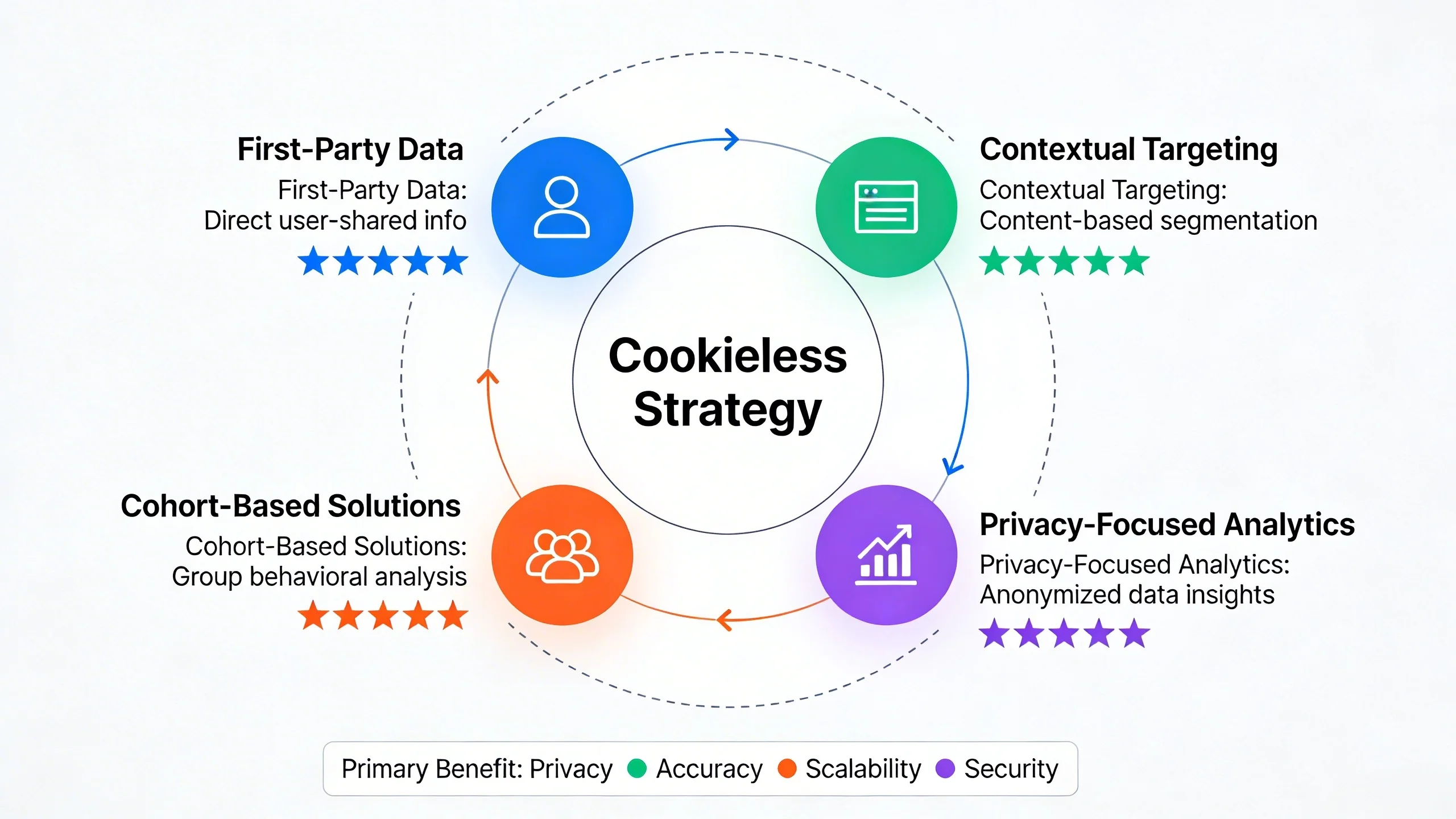
Armed with a growing first-party data asset, you can now deploy a multi-pronged monetization strategy that doesn't rely on third-party tracking. These four pillars form the core of a modern, resilient publishing business.
4 Pillars of a Modern, Cookieless Monetization Strategy
Pillar 1: Master Contextual Advertising
Contextual targeting isn't new, but its modern incarnation is far more powerful. Forget basic keyword matching. "Contextual 2.0" uses advanced AI and natural language processing to analyze the full meaning, sentiment, and nuance of a page—including text, images, and video. This allows for hyper-relevant ads to be placed in brand-safe environments without needing to know anything about the user. An ad for hiking boots appears next to an article about national parks, a simple but highly effective concept.
- Action Step: Partner with ad exchanges and Supply-Side Platforms (SSPs) that have invested heavily in sophisticated contextual targeting technology.
Pillar 2: Explore Identity Solutions
The industry is racing to create privacy-safe replacements for the third-party cookie. These are often called Universal IDs or Authenticated Identity Solutions. In simple terms, solutions like The Trade Desk's Unified ID 2.0 (UID2) or LiveRamp's RampID work by converting a piece of consented user information (like a hashed and encrypted email address) into an anonymized identifier. This ID can then be used by different players across the ad tech ecosystem for targeting and measurement, but without exposing the user's personal data.
- Action Step: Have a conversation with your ad tech vendors. Ask them which identity solutions they support and how you can participate in this new ecosystem.
Pillar 3: Leverage Data Clean Rooms
Think of a data clean room as a secure, neutral digital space. It’s a place where a publisher can bring their anonymized first-party audience data, and an advertiser can bring their anonymized customer data. Inside the clean room, the two datasets can be matched to find overlaps and create high-value targetable segments. The magic is that neither party can see the other's raw data, preserving privacy for both sides.
- Action Step: For publishers with strong direct relationships with large advertisers, exploring data clean rooms can unlock premium, high-CPM campaign opportunities.
Pillar 4: Double Down on Direct-Sold & Premium Ad Formats
In a world without third-party cookies, the value of your direct relationship with your audience skyrockets. Your ability to offer advertisers a guaranteed, known audience in a brand-safe environment is more valuable than ever. This is the time to invest in your direct sales efforts.
- Action Step: Build a comprehensive media kit that showcases your unique first-party audience segments. Move beyond standard banner ads and focus on high-impact sponsorships, branded content, newsletter takeovers, and affiliate marketing partnerships.
Part 5: Demystifying the New Tech: A Publisher's Guide to the Google Privacy Sandbox
Google isn't just removing cookies; it's building a suite of replacement technologies called the Privacy Sandbox. Publishers don't need to be engineers, but understanding the core concepts is crucial for future-proofing your strategy.
What Publishers Need to Know About the Privacy Sandbox
The Topics API
This is Google's solution for interest-based advertising. Instead of tracking individual users, the Chrome browser will observe a user's browsing history on-device and assign them to a few high-level "topics" of interest, like "Fitness" or "Travel & Transportation." When an ad call is made, the browser will share only a few of these general topics, not a specific user ID.
Protected Audience API (formerly FLEDGE)
This is the replacement for retargeting. It allows an advertiser to reach users who have previously visited their site, but the entire ad auction and rendering process happens within the browser on the user's device. This prevents the advertiser from learning about that user's browsing habits on other sites.
Attribution Reporting API
This API is designed to measure ad conversions without using cross-site identifiers. It allows advertisers and publishers to receive aggregate, anonymized reports to understand campaign performance (e.g., "100 people who saw this ad campaign made a purchase") without revealing the identity of the specific individuals who converted.
The Bottom Line for Publishers: You won't need to implement these APIs yourself. The key is to ensure you are working with progressive ad tech partners (your SSP, your ad exchange) who are actively testing and integrating with the Privacy Sandbox APIs. Their readiness will determine your readiness.
Part 6: Your Cookieless Future Checklist
Feeling overwhelmed? Don't be. Start with these concrete, actionable steps today.
A Practical Checklist to Get Started Today
- [ ] Audit your current first-party data collection methods. Where are the gaps? Where are the opportunities?
- [ ] Create a compelling lead magnet (e.g., e-book, webinar) to accelerate your newsletter sign-ups.
- [ ] Review your privacy policy and consent management platform (CMP). Ensure they are transparent, user-friendly, and compliant.
- [ ] Talk to your ad exchange/SSP. Ask them directly about their cookieless solutions, contextual targeting capabilities, and support for identity solutions.
- [ ] Run a pilot campaign with a contextual advertising partner to benchmark its performance against your old strategies.
- [ ] Educate your sales team. Equip them with the language and data to sell the unique value of your first-party audience and direct advertising opportunities.
Conclusion: From Surviving to Thriving
The end of the third-party cookie is not the end of digital advertising. It is the end of an era built on opaque tracking and borrowed data. We are now entering a new era—one defined by transparency, user consent, and direct relationships.
This transition is a powerful forcing function, pushing the entire industry toward a more sustainable and trust-based model. The publishers who view this moment as a mandate to innovate will do more than just survive. By embracing first-party data, investing in high-quality content that earns audience trust, and strategically adopting privacy-first technologies, you will not only replace lost revenue but build a more resilient, valuable, and future-proof business. The future is here. It's time to build.