The Three Pillars of a Perfectly Optimized Ad Stack
Before diving into the "how," it's crucial to understand "why" ad stack optimization has become a non-negotiable priority for modern publishers. The benefits extend far beyond a simple revenue lift; they form the foundation of a sustainable digital business. A finely-tuned ad stack rests on three core pillars.
Maximizing Revenue & Yield
At its core, optimization is about yield management. A strategic ad stack increases competition for every single ad impression. By enabling more demand sources to bid simultaneously (via header bidding) and setting intelligent rules within your ad server, you drive up CPMs and fill rates. This process also plugs "revenue leakage"—lost income from inefficient partner setups, high latency, or technical errors—ensuring you capture the maximum value for your audience's attention.
Enhancing User Experience & Page Speed
Your ad stack is one of the biggest factors impacting your site’s performance. A bloated, inefficient setup with too many client-side partners can drastically slow down page load times, directly harming your Core Web Vitals (CWV). Google uses LCP (Largest Contentful Paint), FID (First Input Delay), and CLS (Cumulative Layout Shift) as key ranking signals. A slow ad experience leads to higher bounce rates, lower user retention, and ultimately, a penalty in search rankings. Optimization ensures your revenue engine doesn't come at the cost of your user experience.
Improving Operational Efficiency
A disorganized ad stack creates a nightmare for your ad ops team. It means endless hours spent on manual tasks, troubleshooting discrepancies, and pulling reports from a dozen different dashboards. A streamlined and optimized stack automates workflows, consolidates reporting into a single source of truth, and provides clearer insights into performance. This frees up your team to focus on high-impact strategic initiatives instead of getting bogged down in the day-to-day technical weeds.
The Anatomy of a High-Performance Publisher Ad Stack
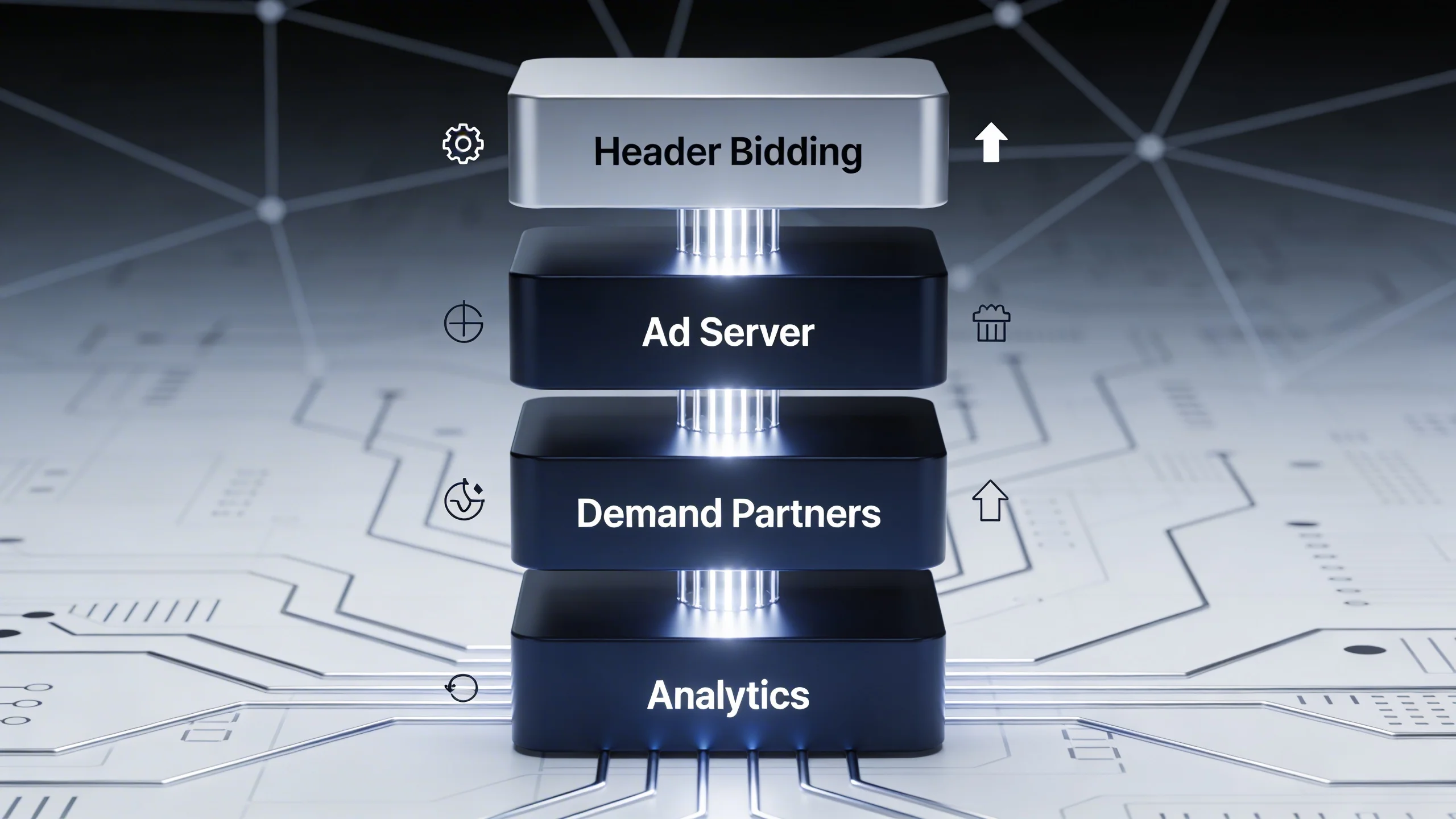
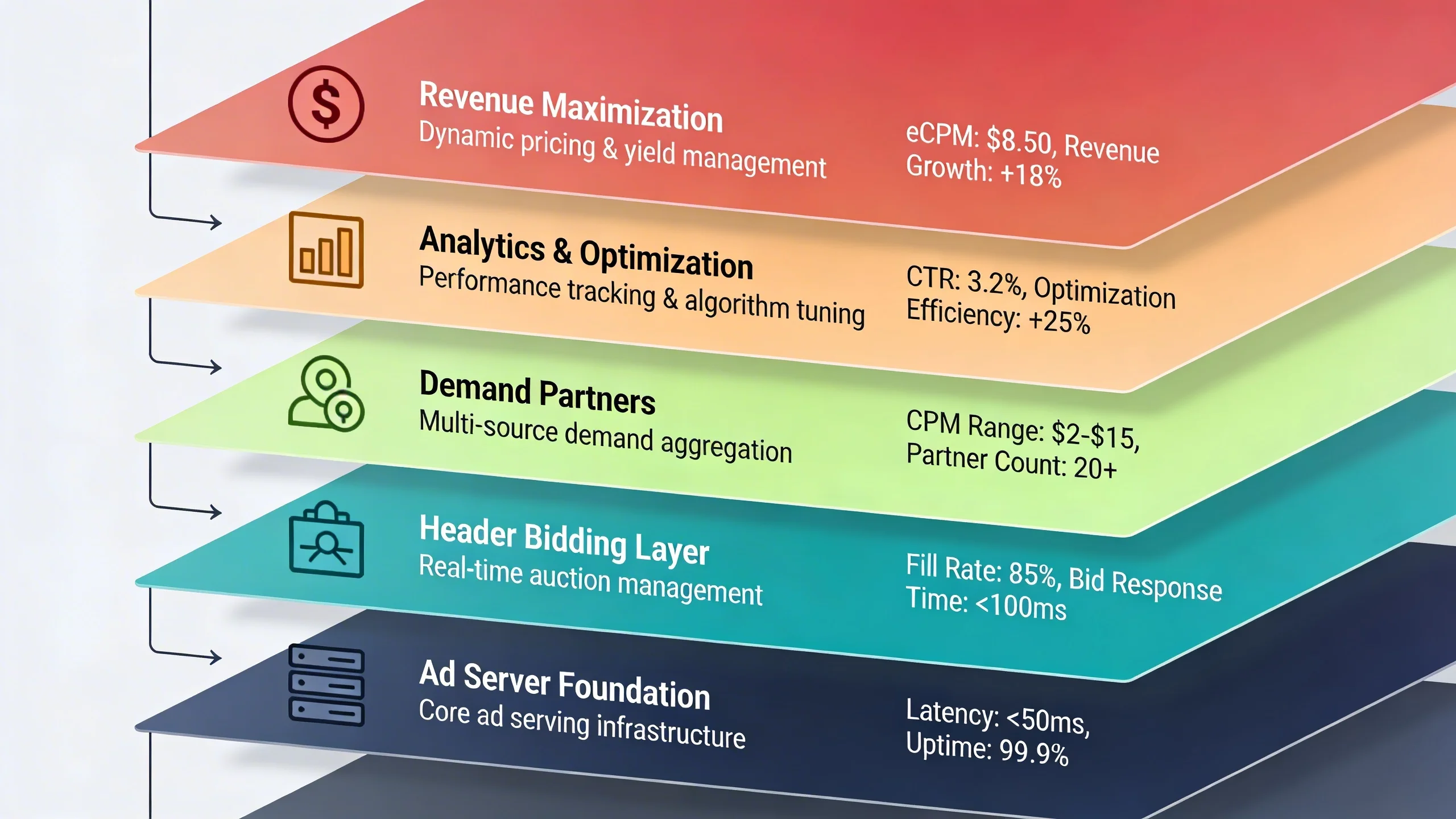
To optimize your revenue engine, you first need to understand its parts. The modern ad stack is a complex ecosystem of interconnected technologies, each playing a critical role. Understanding how they work together is the first step toward building a perfect setup.
[Image: A clean, clear diagram illustrating the core components of a modern ad stack, showing the flow from the user's browser through the CMP, Header Bidding Wrapper, SSPs, and Ad Server.]
1. The Ad Server: Your Central Nervous System
Role: The ad server is the foundational technology and the final decision-maker in your stack. It manages your directly-sold campaigns, houses your programmatic line items, and ultimately decides which ad creative to serve to the user based on a complex set of rules and priorities.
Optimization Focus: Your ad server, most commonly Google Ad Manager, requires meticulous setup. Key optimization levers include structuring your line items for clean reporting and targeting, setting accurate delivery forecasts to avoid under-delivery on direct deals, and establishing clear prioritization rules. Moving away from a legacy "waterfall" setup towards a unified pricing rule structure that allows programmatic demand to compete fairly with direct-sold inventory is the single most important optimization you can make.
Internal Link: For a deeper dive, read our guide on Google Ad Manager Best Practices.
2. The Header Bidding Wrapper: The Great Equalizer
Role: Header bidding revolutionized programmatic advertising by breaking the waterfall. The wrapper is a piece of JavaScript code in your website's header (client-side) or a connection on your server (server-side) that holds a simultaneous, unified auction. It calls multiple demand partners (SSPs) at once, collects their bids, and passes the winning bid to the ad server to compete for the impression.
Optimization Focus: This is where much of the optimization magic happens. Success depends on choosing the right SSP partners, setting aggressive but realistic timeouts (to protect page speed), and deciding on the right setup. A client-side wrapper is easier to implement but can slow down the page, while a server-to-server (S2S) setup is faster but can lead to lower match rates. Many publishers now use a hybrid approach to get the best of both worlds. Solutions like IMC's wrapper are designed to simplify this complexity, offering features like intelligent timeout management and automated A/B testing to maximize performance.
3. Supply-Side Platforms (SSPs) & Ad Exchanges: Your Gateway to Demand
Role: SSPs are the platforms that plug into your header bidding wrapper and connect your inventory to the programmatic marketplace, where thousands of advertisers (via Demand-Side Platforms, or DSPs) are bidding to buy ad space. Each SSP provides access to a unique pool of demand.
Optimization Focus: More is not always better. The key is to work with a curated set of 5-10 high-performing SSPs that bring unique demand and don't create unnecessary latency. Regularly audit your partners' performance (bid rate, win rate, CPMs) and consolidate or remove underperformers. Furthermore, sophisticated floor price optimization—using data to set minimum acceptable prices for your inventory—is critical for preventing advertisers from buying your premium inventory at bargain-basement prices.
4. The Consent Management Platform (CMP): The Gatekeeper of Privacy
Role: In the age of GDPR, CCPA, and other global privacy regulations, a CMP is non-negotiable. This platform presents a notice to users, captures their consent choices regarding data collection and ad personalization, and passes that consent signal downstream to all vendors in your ad stack.
Optimization Focus: An unoptimized CMP can kill your revenue. If it’s slow to load, it delays the entire ad-serving process. If the user experience is confusing, consent rates will plummet, reducing your addressable inventory. Ensure your CMP is compliant with the latest IAB TCF v2.2 framework, loads asynchronously to avoid blocking page content, and has a clear, user-friendly interface. The correct implementation is crucial to ensure the consent string is properly generated and passed to all partners.
Internal Link: Learn more about navigating the complex landscape of Publisher Privacy Regulations.
5. Identity & Data Solutions: Preparing for a Cookieless World
Role: With the deprecation of the third-party cookie, the ability to identify and target users is fundamentally changing. Identity solutions (like Universal ID 2.0, RampID, etc.) and data platforms are becoming essential components of the ad stack. They rely on authenticated user data (like email logins) or other signals to create persistent, privacy-safe identifiers for advertising.
Optimization Focus: The future of ad monetization is rooted in first-party data. Your strategy should focus on building a robust first-party data collection plan (e.g., through newsletters, memberships, or site registrations). From there, evaluate which identity solutions have the most significant adoption and integrate best with your existing SSPs and ad server. The goal is to ensure your inventory remains valuable and addressable to advertisers in a post-cookie world.
6. Ad Quality & Viewability Vendors: Protecting Your Brand & Users
Role: These tools act as your security guards. Ad quality vendors scan ad creatives in real-time to block malware, phishing attempts, and undesirable ad categories (e.g., gambling, political ads) that violate your site policies. Viewability vendors measure whether an ad was actually seen by a user according to industry standards.
Optimization Focus: The balance here is between protection and revenue. Overly aggressive blocking can lower your fill rate, while being too lenient can damage your brand's reputation and harm your users. Set appropriate blocking thresholds based on your brand safety requirements. More importantly, integrate viewability data into your reporting. High-viewability ad units are more valuable to advertisers and can be sold at a premium, making this data a powerful tool for yield optimization.
Your 5-Step Blueprint for Ad Stack Optimization
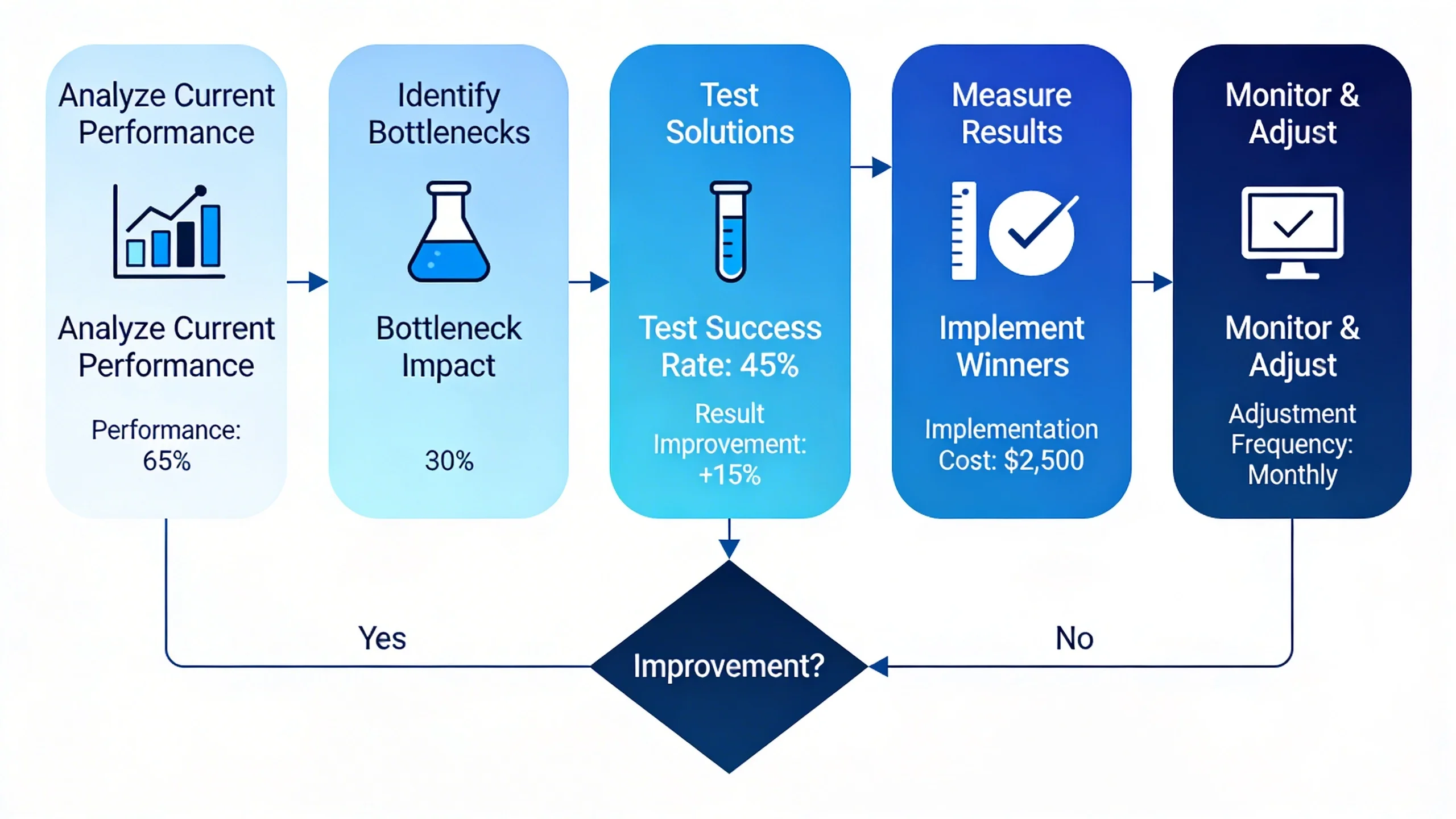
Knowing the components is half the battle. The other half is implementing a strategic, repeatable process for improvement. Ad stack optimization isn't a "set it and forget it" task; it's a continuous cycle of testing and refinement.
Step 1: Audit Your Current Setup
You can't fix what you don't understand. The first step is to create a comprehensive map of your existing ad stack. Document every technology partner (ad server, wrapper, SSPs, CMP), how they are integrated, and how data flows between them. Use browser developer tools and ad diagnostic plugins to identify performance bottlenecks. Which partners are the slowest to respond? Where are the highest latency points in the ad-serving chain? This audit will reveal the low-hanging fruit for immediate improvement.
Step 2: Define Your Goals & KPIs
Effective optimization requires clear, measurable goals. "Make more money" is not a goal; it's a wish. Get specific. Your goals should be tied to key performance indicators (KPIs) that reflect both revenue and user experience. Examples of strong goals include:
- "Increase sitewide ad-driven RPM by 15% in Q3."
- "Improve LCP scores for all article pages to 'Good' within 60 days."
- "Reduce ad-related user complaints by 50% this quarter."
Step 3: Choose Your Technology Partners Wisely
Every partner you add to your stack should justify its existence with performance. When evaluating new vendors—whether it’s an SSP, an identity solution, or a new wrapper—use a strict set of criteria:
- Performance: Do they deliver measurable lift in revenue or speed?
- Transparency: Do they provide clear, granular reporting?
- Support: Is their technical support team responsive and knowledgeable?
- Ease of Integration: How much developer work is required to implement and maintain their solution?
- Future-Readiness: Do they have a clear roadmap for the cookieless future and evolving privacy standards?
A partner should be more than a vendor; they should be a strategic advisor. At IMC, we pride ourselves on excelling in these areas, acting as an extension of your team.
Step 4: Implement, Test, and Measure Everything
Never make a significant change to your ad stack without A/B testing it first. Whether you're adding a new SSP, adjusting header bidding timeouts, or trying a new ad layout, you must isolate the variable and measure its impact against a control group. Run tests long enough to achieve statistical significance. A data-driven testing methodology removes guesswork and ensures that every change you make is a quantifiable improvement.
Step 5: Monitor, Iterate, and Future-Proof
The programmatic landscape is in constant flux. A partner that was a top performer six months ago might be lagging today. New privacy laws can emerge, and new technologies can disrupt the status quo. Optimization is an ongoing discipline. Set up regular quarterly business reviews (QBRs) with your key partners. Continuously monitor your core KPIs. Stay informed about industry trends to anticipate changes and adapt your strategy, ensuring your ad stack remains a competitive advantage.
Beyond the Basics: Advanced Optimization Levers
Once you've mastered the fundamentals, you can pull several advanced levers to squeeze even more value from your ad stack.
- Dynamic Flooring: Instead of setting static price floors for your inventory, use AI and machine learning tools that analyze historical data and real-time demand to set the optimal floor price for every single impression. This prevents you from undervaluing your inventory during demand spikes.
- Ad Refresh & Lazy Loading: Lazy loading is the practice of only loading an ad unit when it's about to scroll into the user's view, which is excellent for Core Web Vitals. Ad refresh (or auto-refresh) reloads the ad slot with a new ad after a set period (e.g., 30 seconds) if the user remains active on the page. When used carefully and on highly engaged pages, this can increase impressions and revenue, but it must be balanced to avoid annoying users or devaluing inventory.
- Video & CTV Monetization: The video and Connected TV (CTV) ad stacks have their own unique complexities, including different ad servers (like Freewheel), ad standards (VAST/VPAID), and demand sources. Optimizing these environments requires a specialized approach focused on reducing latency in the ad pod and maximizing fill for high-value video inventory.
Conclusion: Your Ad Stack is Your Competitive Advantage
In today's digital landscape, a publisher's ad stack is no longer a simple back-end utility; it is a core strategic asset. A well-optimized stack is the engine that drives revenue, the guardian of your user experience, and the foundation of your operational efficiency. It is, without a doubt, one of your most significant competitive advantages.
The process of deconstructing, analyzing, and rebuilding your ad tech setup can seem daunting. But by taking a methodical, data-driven approach—auditing your current state, setting clear goals, choosing partners wisely, and committing to a cycle of continuous testing and iteration—you can transform your ad stack from a liability into a powerful engine for sustainable growth.
---
Call to Action (CTA)
Feeling overwhelmed by the complexity? Your ad stack might be leaving money on the table. Schedule a free ad stack audit with one of our experts today and get a personalized roadmap for increasing your revenue.
---
Frequently Asked Questions (FAQ)
Q1: How often should I optimize my ad stack?
Optimization should be an ongoing process, not a one-time project. We recommend a full audit of your partners and setup at least twice a year. However, you should be monitoring performance KPIs on a weekly basis and running A/B tests on new partners or configurations on a monthly or quarterly basis.
Q2: What's the difference between a client-side and server-side header bidding wrapper?
A client-side wrapper runs the auction in the user's browser. It's easier to set up and offers better cookie-matching for user identification. However, it can add latency and slow down your page. A server-side (S2S) wrapper runs the auction on an external server. This is much faster for the user but can result in lower CPMs due to poorer user-match rates. Most publishers today use a hybrid model, running a few key partners client-side and the rest server-side.
Q3: How does my ad stack affect my site's SEO?
Your ad stack has a direct and significant impact on SEO. A slow, heavy ad stack will hurt your Core Web Vitals scores, which are a confirmed Google ranking factor. Slow-loading ads and layout shifts caused by ads create a poor user experience, increasing bounce rates and signaling to Google that your page is low-quality. A fast, streamlined ad stack is essential for both revenue and organic search performance.
Q4: Can I build my own ad stack or should I use a managed service?
Building your own ad stack using open-source tools like Prebid.js gives you maximum control and transparency. However, it requires significant in-house engineering and ad ops resources to manage, maintain, and optimize. A managed service or monetization partner handles the technology, partner relationships, and optimization for you, typically for a revenue share. The right choice depends on your team's size, technical expertise, and business goals.