First, Let's Define the Playing Field: AdSense vs. Managed Partners
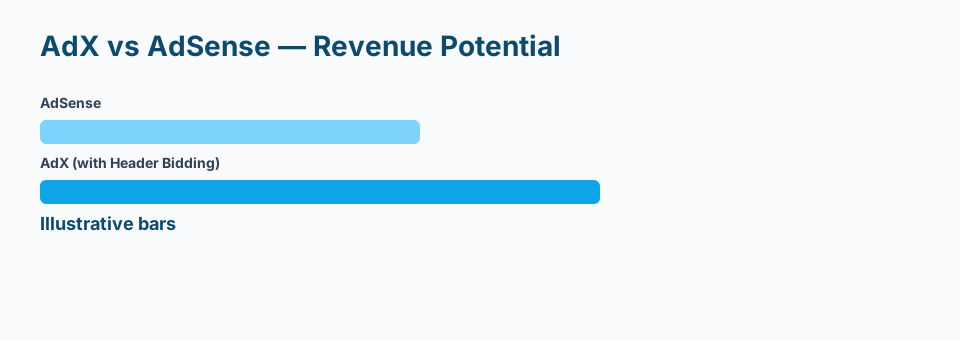
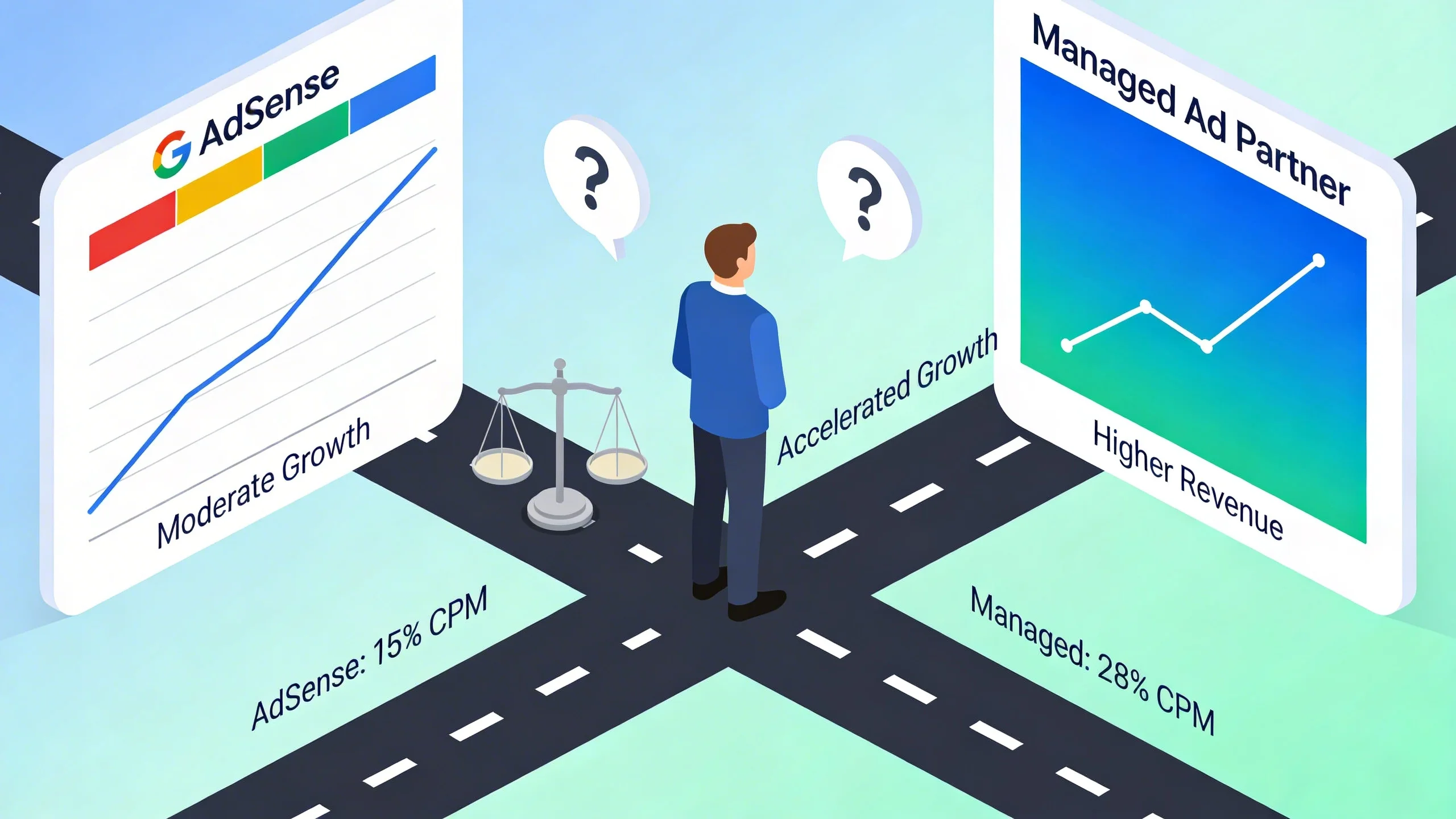
Before we dive into the signs, it’s crucial to understand the fundamental difference between these two approaches to monetization. They aren't just different products; they're entirely different business models.
What AdSense Is (And Isn't)
Think of AdSense as a self-serve tool. Google provides the technology, and you do the rest.
- The Good: Its biggest strengths are its accessibility and simplicity. The barrier to entry is incredibly low, the setup is straightforward, and the payments are reliable. For a brand-new blog, it's the perfect "set it and forget it" solution to start earning your first dollars.
- The Limitations: The simplicity of AdSense is also its biggest weakness. You are plugged into a single demand source: Google's ad network. This means you're only getting Google's best price, not the entire market's best price. Furthermore, it offers minimal support, provides only basic optimization tools, and its Auto Ads can significantly impact site speed and Core Web Vitals if not carefully managed.
What a Managed Ad Partner Does Differently
A managed ad partner isn't a tool; they are your dedicated ad operations (Ad Ops) team. They act as your monetization department, and their financial success is directly tied to yours.
- The Core Difference: Instead of giving you a tool and wishing you luck, a managed partner actively manages your entire ad strategy for you.
Here are their key functions:
- Advanced Technology: They implement and manage a sophisticated "ad stack," with a technology called header bidding at its core. This is the engine that drives higher revenue.
- Increased Competition: Header bidding pits dozens of ad networks and exchanges (including Google's) against each other in a real-time, lightning-fast auction for every single ad spot on your page. This massive competition is what drives up your Cost Per Mille (CPM) and, ultimately, your total revenue.
- Holistic Support: You're no longer alone. A good partner provides expert advice on everything from optimal ad placements to improving site speed and navigating industry changes. You have a team of pros in your corner.
- Premium Services: Many top-tier partners offer value-adds you can't get from AdSense, like exclusive high-earning video players, content creation tools, and deep data insights to help you grow your business.
The 7 Telltale Signs You've Outgrown AdSense
This is the heart of the matter. If you find yourself nodding along to several of these points, it's a strong signal that you're leaving a significant amount of money on the table.
Sign #1: Your Traffic Has Reached a Critical Threshold
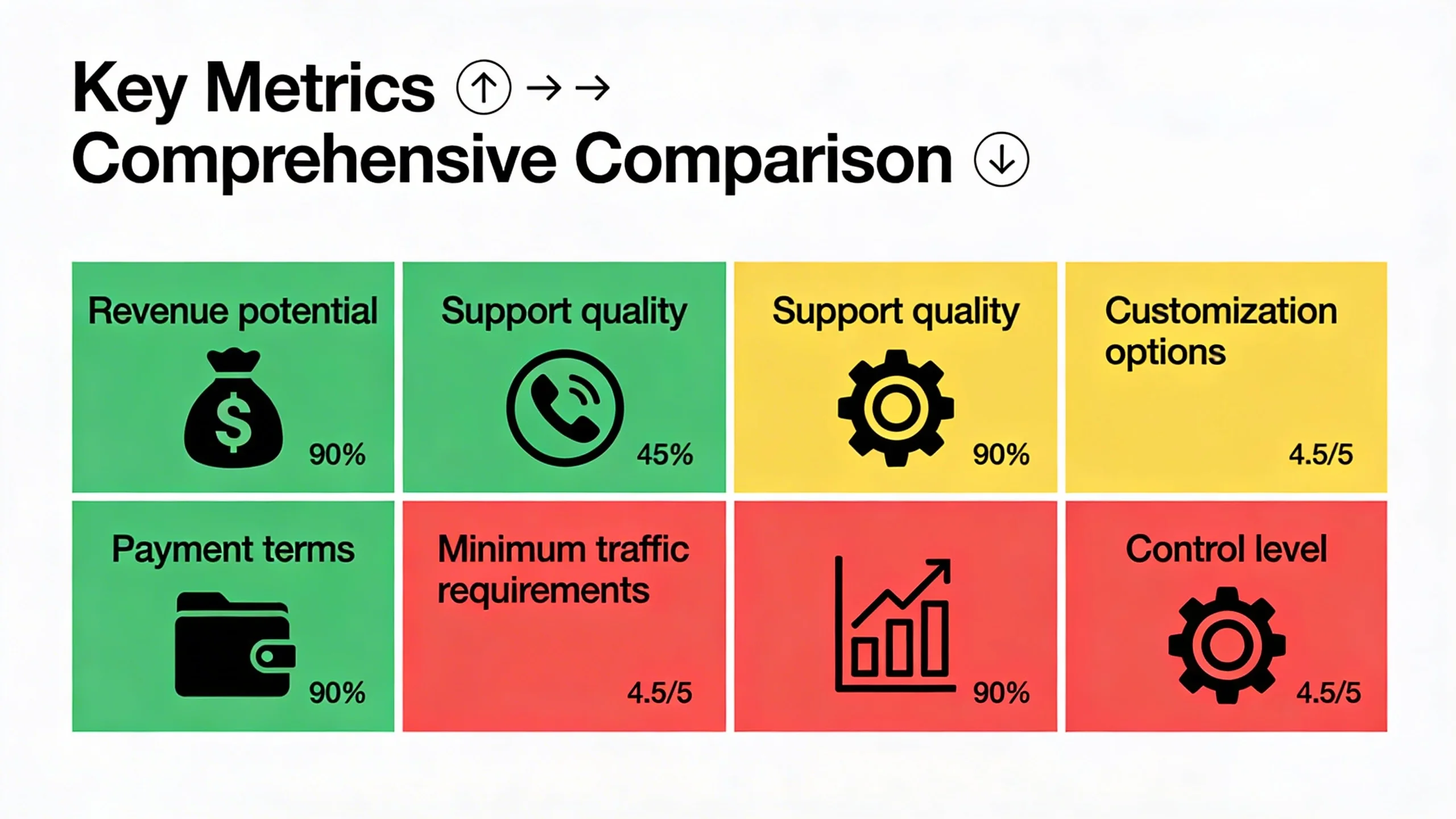
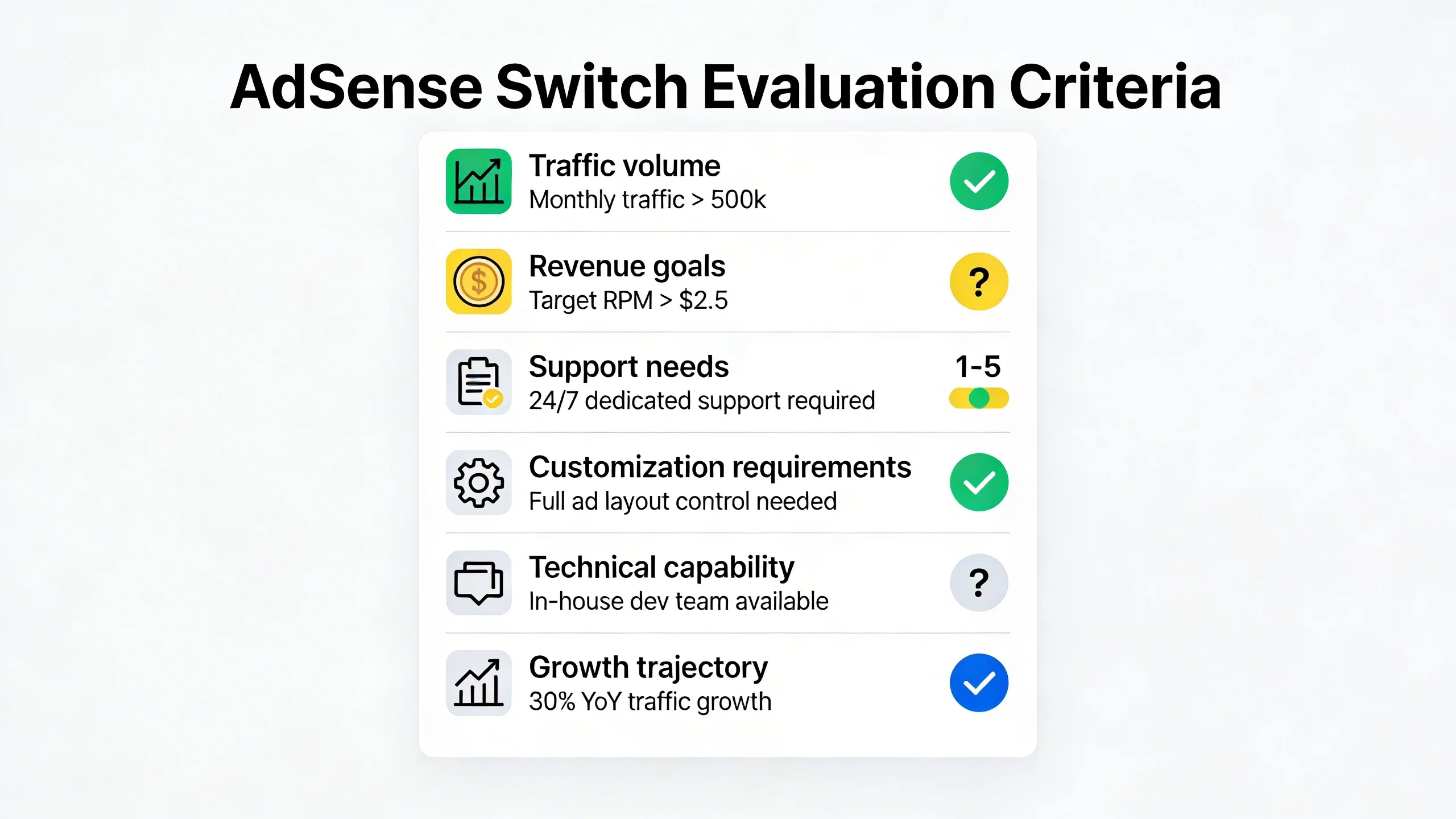
While AdSense is great for sites of any size, the world of premium ad management opens up once you hit a certain scale. Managed partners have varying traffic requirements — Mediavine requires 50,000 monthly sessions, Raptive requires 100,000 pageviews, and top-performing partners like IMC require 250,000 monthly pageviews for their premium service with 90/10 revenue share and NET 30 payments.
Why this matters: This isn't an arbitrary number. This traffic level is the point where the advanced technology of header bidding truly starts to shine. With tens of thousands of ad impressions every day, the lift in CPM from increased competition creates a dramatic and meaningful increase in your overall revenue. Below this threshold, the complexity of a full ad stack might not yield returns that justify the switch.
Actionable Advice: Open your Google Analytics right now. Go to Reports > Engagement > Pages and screens. Set your date range for the last 30 days and look at your "Sessions." If you're consistently above 50,000, you have officially crossed the threshold. It's time to start exploring.
Sign #2: Your RPMs Have Stagnated or Feel Disappointingly Low
RPM, or Revenue Per Mille, is the estimated earnings you accrue for every 1,000 impressions. It's the ultimate health metric for your ad monetization. A common frustration for growing publishers is watching their traffic double while their RPM stays flat or even decreases.
This is the "AdSense Ceiling." Because you're limited to Google's network, there's a natural cap on how much advertisers are willing to bid within that single ecosystem. You can get more traffic, but you can't fundamentally increase the value of each visitor.
Why managed partners break this ceiling: Imagine you're selling a valuable antique. AdSense is like taking it to a single pawn shop and accepting their offer. A managed ad partner is like taking it to a Christie's auction, where dozens of the world's wealthiest collectors bid against each other, driving the price sky-high. By introducing more demand sources, header bidding creates that auction environment for every ad impression, consistently breaking through the AdSense Ceiling and increasing your RPM.
Sign #3: You're Spending More Time Tinkering with Ads Than Creating Content
Does this sound familiar? You spend hours moving ad blocks around, A/B testing different sizes, trying to decipher AdSense reports, and reading forums, all for a 2% lift in revenue.
Your time is your most valuable asset. Every hour you spend trying to be a mediocre ad technician is an hour you're not spending on what you do best: creating the high-quality content that grows your audience and your business.
This is where the "managed" part of a managed partner becomes a game-changer. They handle everything:
- Setting up and optimizing the header bidding wrapper.
- Testing and implementing the highest-performing ad placements.
- Monitoring ad performance and making continuous adjustments.
- Managing relationships with all the different ad networks.
You are effectively outsourcing your entire ad department to a team of experts, freeing you up to focus on your core business.
Sign #4: Site Speed and Core Web Vitals Are a Constant Worry
In today's SEO landscape, user experience is paramount. Google's Core Web Vitals (CWV)—metrics like Largest Contentful Paint (LCP) and Cumulative Layout Shift (CLS)—are direct ranking factors. One of the biggest fears for publishers is that loading up on ads will slow down their site, hurt their user experience, and damage their search rankings.
It's a valid fear. Unoptimized AdSense code, especially Auto Ads, can be heavy. It can cause content to jump around (high CLS) and slow down the initial page load (high LCP), sending negative signals to Google.
Top-tier managed partners understand this better than anyone. Their survival depends on keeping publisher sites fast and healthy. They invest heavily in technology like:
- Lazy Loading: Ads only load when a user is about to scroll them into view, dramatically improving initial page load times.
- Lightweight, Asynchronous Ad Code: Their code is designed to load independently of your content, so your articles appear instantly for the user, even while the ad auction happens in the background.
A great partner helps you earn more money without sacrificing user experience or SEO. They are an ally in your site speed goals, not an obstacle.
Sign #5: You're Concerned About Low-Quality or Irrelevant Ads
You've worked hard to build a trusted brand and a beautiful website. The last thing you want is a spammy, low-quality "get rich quick" or "one weird trick" ad appearing next to your expert content.
While AdSense offers some controls, it can be a constant battle of whack-a-mole to block bad ad categories. This brand damage is a real cost.
Managed ad partners offer superior ad quality controls. They work with premium brands and have sophisticated filtering systems and dedicated teams to ensure the ads on your site are high-quality and relevant. They provide extensive blocklists and give you granular control, protecting the reputation you've worked so hard to build.
Sign #6: You Need Real Support and Strategic Guidance
What happens when your AdSense revenue suddenly drops 30% overnight? You might post on a forum, read some generic help documents, and hope for the best. With AdSense, you're essentially on your own.
Now, imagine that same scenario with a managed partner. You send an email to your dedicated support contact—a real person who knows your site and your history. They can investigate your specific account, analyze your traffic, and provide a clear answer, whether it's a seasonal dip in ad spend or a technical issue they can help you resolve.
This is a monumental difference. A partner provides more than just technology; they provide a partnership. They can offer strategic guidance on how new ad units might perform, give you a heads-up about upcoming industry changes (like the shift to a cookieless world), and help you navigate the complexities of programmatic advertising.
Sign #7: You're Thinking Like a Business Owner, Not Just a Hobbyist
This is the ultimate sign. The switch from AdSense to a managed partner is a fundamental shift in mindset. It's the moment you stop treating your website like a side project and start treating it like the valuable business asset it is.
A business owner's primary goal is to maximize the return on their assets. Your content and the audience you've built are your most valuable assets. Relying on a basic, entry-level tool like AdSense is like owning a prime piece of commercial real estate and only renting it out as a storage unit. You're leaving immense value on the table.
Leaving AdSense isn't about abandoning a tool that helped you start. It's about graduating to a professional service that aligns with your new business goals. It's about professionalizing your operation.
---
Think you might be ready? Use our free revenue calculator to estimate your potential earnings with a managed ad partner. Try our Revenue Calculator
---
The Process: What to Expect When You Make the Switch
The idea of switching can feel intimidating, but premium partners have streamlined the process to make it as painless as possible.
The Application & Vetting Process
First, you'll apply on the partner's website. They will review your site to ensure it meets their criteria, which typically includes:
- Traffic: Meeting their minimum session requirements.
- Content Quality: Your content must be original, high-quality, and engaging.
- Brand Safety: Your site must be in a brand-safe niche (e.g., no adult content, hate speech, etc.).
Onboarding and Implementation
Once you're approved, the technical part is surprisingly simple. You don't need to be a developer. The process usually involves two main steps:
- Removing all the old AdSense code snippets from your site.
- Adding a single line of JavaScript provided by your new partner to your site's header.
Their support team will guide you through this entire process.
The "Ramp-Up" Period
It's important to set realistic expectations. Your revenue won't triple on day one. It typically takes 30-60 days for the new ad stack to fully "learn" your audience and optimize. During this "ramp-up" period, the system is gathering data, and new demand partners are being integrated into your auction. Be patient, and you'll see your RPMs steadily climb to their new, higher baseline.
FAQ: Your Lingering Questions Answered
How much more can I realistically earn?
While every site is different, many publishers see a 50% to 300% increase in their RPM after switching from AdSense alone to a managed ad partner. The increase is most dramatic for sites with high-quality content and significant traffic from valuable geos like the US, UK, Canada, and Australia.
Will I lose my AdSense account?
No, and this is a common misconception. You keep your AdSense account. In fact, your managed partner will integrate your AdSense account directly into their header bidding auction. This ensures Google is still competing for your inventory, so you get the best of both worlds—Google's bids plus bids from dozens of other networks.
Is there a long-term contract?
Most reputable managed ad partners do not require long-term, lock-in contracts. They are confident that the superior performance and support they provide will be more than enough to keep you as a happy client. Typically, there is only a 30-day notice period if you ever decide to leave.
What happens if my traffic dips below the minimum requirement?
Partners understand that traffic can be seasonal. If you have a temporary dip below the minimum (for example, a food blog after the holidays), they will typically work with you. They look for long-term consistency and are supportive partners in your growth, not punitive.
Conclusion: AdSense is the Start, Not the Destination
You've worked incredibly hard to build your audience and create content that matters. Now, it's time to ensure your monetization strategy has grown with you.
Let's recap the signs that you're ready for an upgrade:
- Your traffic has surpassed the 50k+ session threshold.
- Your RPMs have hit a ceiling.
- You're spending too much time on ad management.
- You're worried about site speed and Core Web Vitals.
- You want to protect your brand with higher-quality ads.
- You need real, expert support.
- You're ready to run your site like a business.
Don't leave money on the table with a monetization strategy that's holding you back. Making the switch from AdSense to a managed ad partner is the single most impactful financial decision a maturing publisher can make.
It's time to get paid what your content is truly worth.
---
Primary CTA: Ready to unlock your site's true revenue potential? Learn more about our services and apply today. Our publisher success team is excited to review your site.
Secondary CTA: Have more questions? Check out our case studies to see how we've helped publishers just like you.