

The Old Way: Why the Ad "Waterfall" Was Leaking Your Revenue
To understand why header bidding is so revolutionary, you first need to understand the flawed system it replaced: the programmatic waterfall.
Imagine you're selling a valuable car. Using the waterfall method is like offering it to the first potential buyer for $10,000. If they say no, you move to the next person and offer it for $9,000, then the next for $8,000, and so on down a list. The problem? Someone who was fourth in line might have been willing to pay $12,000, but they never got the chance to bid because the person ahead of them agreed to the lower $9,000 price. You just lost $3,000 without even knowing it.
This is precisely how the ad waterfall (or daisy-chaining) worked. Your ad server would call ad networks one by one, in a fixed order. This created several major pain points for publishers:
- Lost Revenue: The highest bidder often never got a chance to bid if they were lower down the priority list. This systemic flaw meant publishers consistently failed to capture the true market value of their impressions.
- High Latency: Calling ad networks sequentially is slow. Each network has to respond before the next can be called, which can delay page loading, harm the user experience, and lead to unfilled ad slots (passbacks).
- Lack of Transparency: The process was a black box. Publishers had little insight into why certain partners were prioritized or how much demand partners were actually willing to pay for an impression that was sold upstream for less.
What is Header Bidding? The Simple Explanation
So, what is header bidding? In one sentence: *Header bidding is an advanced programmatic technique that allows publishers to offer their ad inventory to multiple ad exchanges simultaneously before making a call to their ad server.*
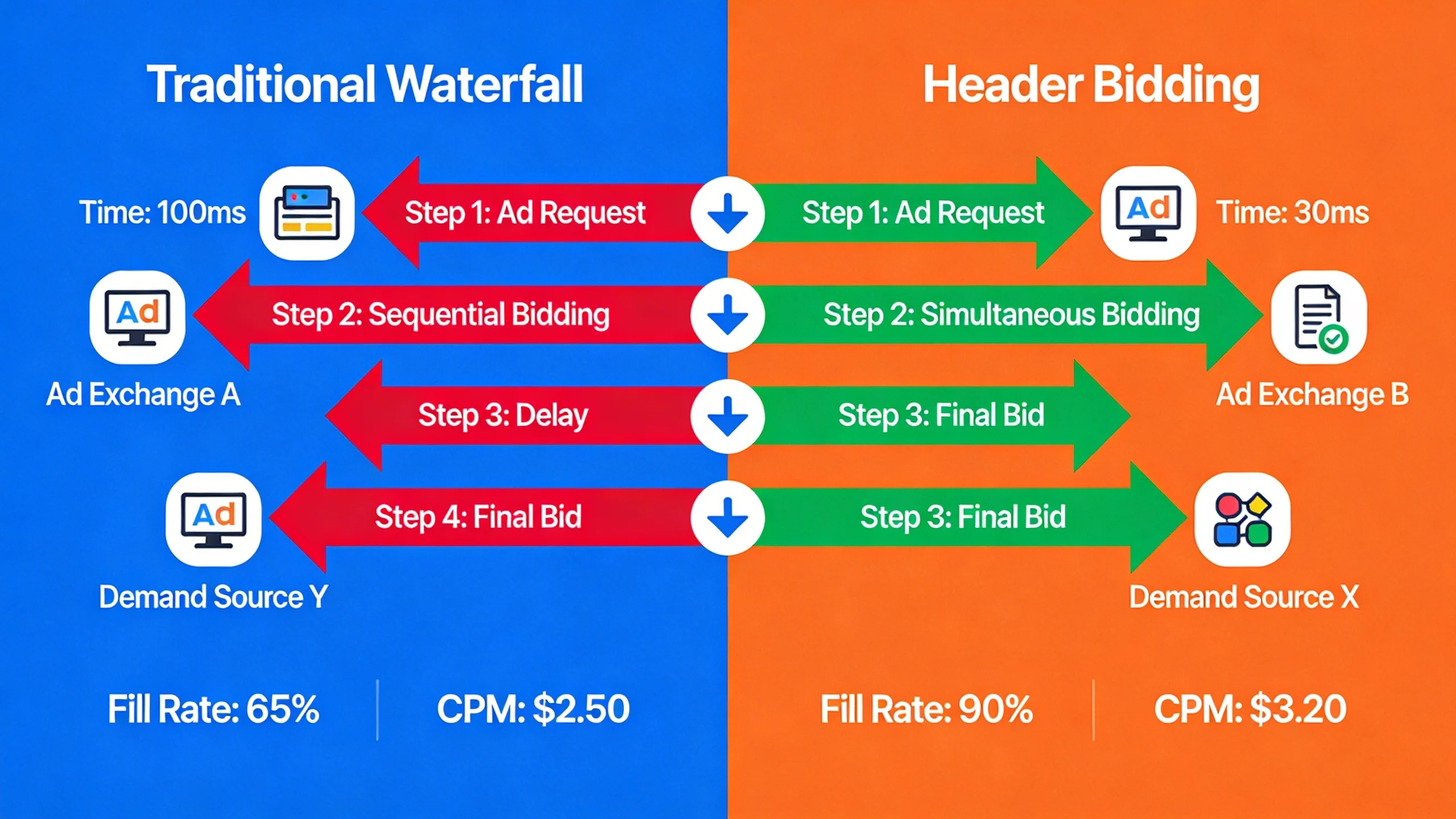
Let's revisit our car-selling analogy. Instead of asking buyers one by one, header bidding is like putting your car up for a live auction and inviting all potential buyers to bid at the same time. Everyone hears the bids, everyone gets a fair chance, and the highest bidder wins, every single time. You get the maximum possible price for your car.
In the world of ad tech, this "auction" is managed by a piece of code called a header bidding wrapper. Think of the wrapper as an expert auction manager. It’s a JavaScript container that sits in the <head> section of your website's HTML, organizing the bidding process, collecting all the bids from your demand partners, and sending the winner to your ad server. The most popular open-source framework for this is Prebid.js, which has become the industry standard.
The core principle is simple but powerful: header bidding moves your ad sales from a slow, sequential line to a unified, simultaneous auction to maximize competition and, therefore, your revenue.
How Does Header Bidding Actually Work? (A Step-by-Step Breakdown)
While the concept is straightforward, the technology behind header bidding happens in a fraction of a second. Here’s a simple, step-by-step look at the process.
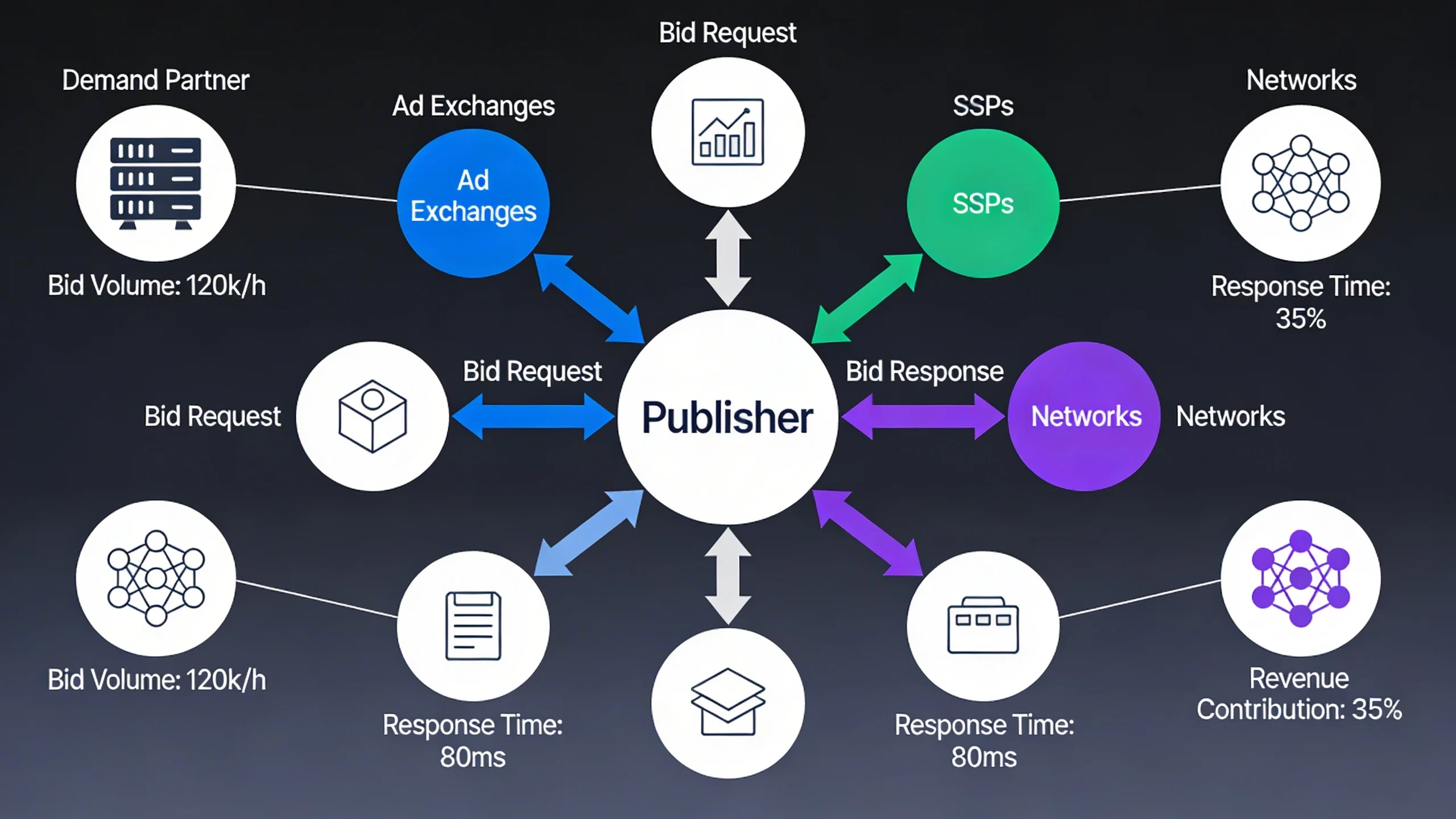
[Insert Diagram 2: A step-by-step flowchart of how a header bidding auction works.]
- User Visits Your Site: The entire process kicks off the moment a visitor lands on your webpage.
- The Wrapper Activates: A piece of JavaScript in your site's
<head>section—the header bidding wrapper—is triggered. - Bids are Requested: The wrapper immediately sends out simultaneous bid requests to all your connected demand partners (SSPs and ad exchanges).
- Demand Partners Respond: Each partner holds a rapid, internal auction among their advertisers and sends their single highest bid back to the wrapper on your page. To protect user experience, a timeout is set (e.g., 500 milliseconds) to ensure a slow partner doesn't hold up your entire site.
- The Winning Bid is Chosen: The wrapper reviews all the bids it received before the timeout and identifies the highest one.
- The Ad Server is Called: The winning bid information (the price and the creative) is passed to your ad server, typically Google Ad Manager, using key-value pairs.
- The Final Auction: This is the crucial last step. Your ad server runs its own auction, comparing the winning bid from the header bidding auction against all other demand sources it manages, such as direct-sold campaigns and Google's own Ad Exchange (AdX).
- The Ad is Served: The true highest bidder from this final, unified auction wins the impression, and their ad creative is displayed to the user.
The Top 4 Benefits of Header Bidding for Publishers
Adopting header bidding isn't just a technical upgrade; it's a fundamental business strategy that delivers tangible results. Here are the four biggest advantages for publishers.
Massive Revenue Lift
This is the primary reason publishers switch. By forcing all demand sources to compete in a fair and simultaneous auction, you drive up the price (CPM) for every impression. The waterfall method left money on the table; header bidding captures it. It's not uncommon for publishers to report a 20-60% increase in programmatic revenue after properly implementing a header bidding solution.
Increased Competition & Demand
Header bidding allows you to plug into numerous SSPs and ad exchanges simultaneously, far more than were practical in a waterfall setup. More bidders in the auction means more competition, which naturally leads to higher prices and a better fill rate for your ad inventory.
Unprecedented Transparency
Unlike the black-box nature of the waterfall or even some of Google's solutions, header bidding gives you clear visibility into your ad auctions. You can see exactly who is bidding on your inventory, how much they are willing to pay for each impression, and which partners are performing best. This data is invaluable for optimizing your yield.
Better Yield Management
With the transparency and control header bidding provides, you can make smarter decisions. You have the data to set intelligent floor prices, A/B test new demand partners, and understand the true value of your audience segments. It transforms ad operations from a guessing game into a data-driven strategy.
Header Bidding vs. The Waterfall vs. Google's Open Bidding
Header bidding doesn't exist in a vacuum. It was created to solve the waterfall's problems, and in response, Google created its own alternative. Here’s how they stack up.
[Insert Comparison Table: A clear table comparing Waterfall vs. Header Bidding vs. Google Open Bidding on key features like Auction Type, Transparency, Setup Complexity, and Revenue Potential.]
- Waterfall: The old method. It's sequential, inefficient, and leaves significant revenue on the table. It is largely considered obsolete by modern publishers.
- Header Bidding (via Prebid): The open-source industry standard. It runs a transparent auction (either in the user's browser or server-side) that gives publishers maximum control and transparency. It requires more technical setup but offers the highest potential.
- Open Bidding (formerly EBDA): This is Google's answer to header bidding. It's a server-to-server (S2S) auction run by Google within its own ecosystem (Google Ad Manager). It's easier to set up than a custom Prebid implementation but offers less transparency and control, effectively keeping you within Google's walled garden.
Client-Side vs. Server-Side (S2S): What's the Difference in 2025?
When you implement header bidding, you have two primary architectural choices. Understanding the difference is key to building a setup that is both fast and profitable.
Client-Side Header Bidding
- How it works: The auction runs directly in the user's web browser (the "client"). The wrapper JavaScript on your page calls each demand partner individually.
- Pros: Generally easier to implement and historically offered better cookie and ID matching, as the bids happen directly in the environment where cookies live.
- Cons: Can increase page latency. Each additional partner adds another process that has to run in the browser, which can slow down page load times if not managed carefully.
Server-Side Header Bidding (S2S)
- How it works: The browser makes a single call to a central ad server. That server then calls all the demand partners on your behalf.
- Pros: Massively reduces page latency because the heavy lifting is moved off the user's browser. This allows you to add many more demand partners without slowing down your website.
- Cons: Can have lower user ID match rates because the auction happens on a separate server, away from the user's browser cookies. However, this gap is closing rapidly with new identity solutions.
The Future is Hybrid
In 2025, the debate is no longer strictly client-side vs. server-side. The most sophisticated publishers use a hybrid approach. They run a few of their top-performing partners client-side to maximize ID matching and revenue, and run the rest of their demand partners through an S2S connection to maintain site speed. This hybrid model delivers the best of both worlds: optimal revenue and a superior user experience.
Looking Ahead: Header Bidding in a Cookieless World (2025 and Beyond)
The phase-out of third-party cookies is the single biggest shift in digital advertising today, and header bidding is at the center of the solution for publishers.
- The Rise of Universal IDs: The end of third-party cookies challenges traditional user targeting. In response, the ad tech industry has developed alternative identity solutions (like Unified ID 2.0, RampID, and others). Header bidding, and specifically the Prebid framework, is the primary vehicle for publishers to adopt these new IDs. This allows you to continue offering addressable, valuable inventory to advertisers without relying on a dying technology.
- First-Party Data is King: In a privacy-first world, your first-party data (information you collect directly from your users with their consent) is your most valuable asset. Header bidding allows you to enrich bid requests with this data, making your inventory significantly more attractive and valuable to advertisers looking for specific audiences.
- AI and Machine Learning: The future of header bidding is smarter. AI is increasingly being used to dynamically optimize auction timeouts, intelligently select the best demand partners for each impression, and set data-driven floor prices, further automating and maximizing your yield.
How to Get Started with Header Bidding: A 3-Step Overview
Ready to make the switch? This isn't a full technical guide, but a strategic overview of the first steps.
- Choose Your Path: Managed vs. Self-Serve: You have two main options. A managed header bidding provider will handle the entire setup, maintenance, partner relationships, and optimization for a revenue share. This is the best option for most publishers who lack a dedicated in-house AdOps engineering team. A self-serve (DIY) approach using Prebid.js offers maximum control but requires significant technical expertise to build and maintain.
- Select Your Demand Partners: Don't add twenty partners on day one. Start with 5-10 high-quality SSPs that are relevant to your geography and audience content. A good managed partner will help you with this selection.
- Implement, Test, and Optimize: Header bidding is not a "set it and forget it" solution. Once implemented, it's crucial to test its impact on page latency and revenue lift. Continuously monitor partner performance and optimize your setup to ensure you're getting the best results.
Frequently Asked Questions (FAQ)
Is header bidding still relevant in 2025?
Yes, more than ever. It has evolved from a simple revenue hack into the foundational technology for publisher monetization. It's the primary framework for navigating the cookieless future, leveraging first-party data, and integrating new identity solutions.
How much revenue uplift can I realistically expect?
While results vary based on your site traffic, geography, and previous setup, most publishers see a significant programmatic revenue lift between 20% and 60%. The key to achieving these results is a proper, well-optimized implementation.
Does header bidding slow down a website?
If implemented poorly (e.g., a client-side setup with too many partners and long timeouts), yes, it can. However, modern server-side and hybrid solutions are specifically designed to minimize latency. With proper timeout management and a smart setup, the impact on site speed is negligible.
Can I use header bidding with Google AdSense/AdX?
Yes, absolutely. Header bidding doesn't replace Google Ad Manager; it works with it. The winning bid from your header bidding partners is sent into Google Ad Manager to compete directly against Google's own demand (Ad Exchange) and your direct deals. This ensures the highest price always wins, regardless of where it comes from.
Conclusion: Take Control of Your Ad Revenue
Header bidding is more than just a piece of ad tech; it's a strategic shift. It replaces the outdated, inefficient waterfall with a fair, transparent, and unified auction. The result is more competition for every impression, more transparency into your demand, and ultimately, more revenue for your business.
In 2025, it's the essential tool that puts publishers back in the driver's seat, empowering you to maximize the value of your content and your audience.
Ready to see what a unified auction can do for your bottom line? Contact our ad monetization experts today for a free analysis of your current setup.